
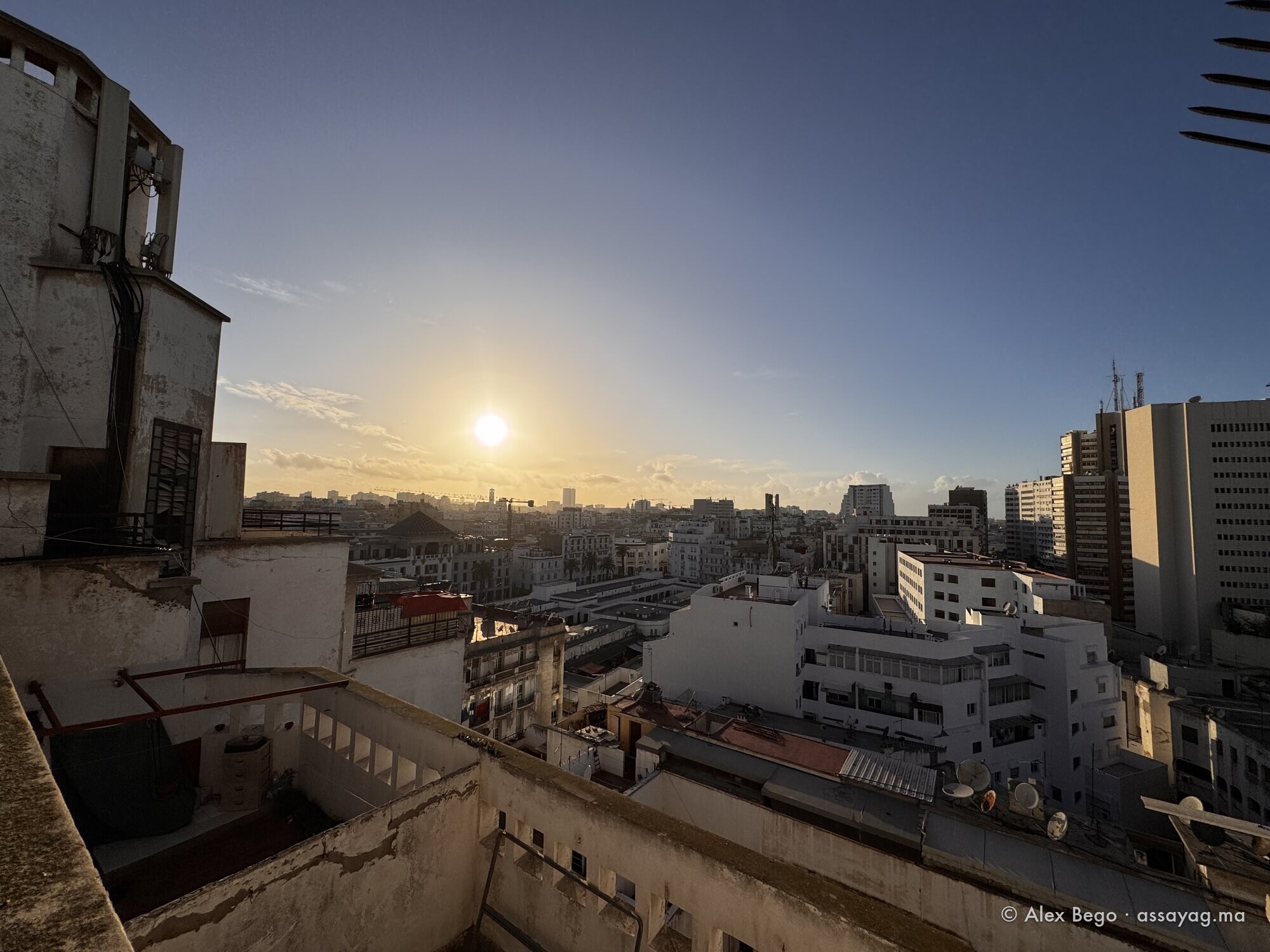
At the foot of nearly every article on this site, the same two names come back: Monique Eleb and Jean-Louis Cohen. This is not academic courtesy. Without their work there would be almost nothing to read about the Immeuble Assayag — or about half the buildings that make up the silhouette of Casablanca.
Both died in 2023, ten weeks apart.
Monique Eleb, born in Casablanca
She was born in Casablanca on 2 September 1945 and died in Paris on 26 May 2023. A sociologist and psychologist by training, she devoted her career to a simple and little-visited question: how do people actually inhabit the dwellings architects draw for them?
She taught at the École d'architecture de Paris-Villemin, then was among the founders of the École nationale supérieure d'architecture de Paris-Malaquais in 2001. In 1991 she created, with Jean-Louis Cohen, the laboratory Architecture, culture et société, which she directed until 2012.
One detail matters especially here: it was she who was behind the founding, in 1995, of Casamémoire — the association that defends the modern architectural heritage of Casablanca, and that organises today the Heritage Days during which the Assayag opens its basements to the public.
Jean-Louis Cohen, the historian
Born in Paris on 20 July 1949 and died on 7 August 2023, he trained as an architect and became one of the most widely read historians of modern architecture of his generation. From 1994 he held the Sheldon H. Solow Chair in the History of Architecture at New York University's Institute of Fine Arts.
His work reached far beyond Morocco — Le Corbusier, Soviet architecture, the architecture of war, exhibitions at the Centre Pompidou and MoMA. But Casablanca stayed with him for thirty years, and he returned to it until the end.
Twelve years, three books
Their joint work on Casablanca spanned twelve years and produced three books: Casablanca. Mythes et figures d'une aventure urbaine (Hazan, 1998), Casablanca, portrait de ville (1999) and Les Mille et Une Villes de Casablanca (2003).
The first remains the reference. Four hundred and seventy-eight pages, French and Moroccan archives, hundreds of unpublished photographs, and one argument: the Casablanca of the twentieth century is not an accidental colonial backdrop but an urban laboratory, and must be read as one. The book has been reprinted several times and translated.
What their gaze changes for the Assayag
Before them, a 1930s rental block was not an object of heritage. It was simply a building: you lived in it, you repainted it, you demolished it if it came to that. It took a generation of researchers to establish that a façade from 1930 deserved the same seriousness as an ancient monument — and to give residents the words with which to defend their home.
Cohen returned to the Assayag in 2021, in a study of Jewish architecture in Casablanca published by the journal Quest. Of the building commissioned by Moses Assayag he wrote:
"Even more daring is the Moses Asayag building, sponsored by another Jew from northern Morocco (1930-1932). With its ten floors, it would not have been tolerated in Paris at the time."
Jean-Louis Cohen, "Casablanca la juive: Public and Private Architecture 1912-1960", Quest, no. 19, 2021, p. 23.
It is, as far as we know, one of the last times he wrote about this building. Two years later he was gone.
2023
Monique Eleb died on 26 May. Jean-Louis Cohen on 7 August, suddenly, at seventy-four, while on holiday. Ten weeks between the two dates.
The books go on doing their work. Every time a visitor stops in front of the three towers and wonders why they are there, they are using — without knowing it — words that those two put in place.
Sources: biographical notices for Monique Eleb and Jean-Louis Cohen (Wikipedia; Society of Architectural Historians; Artforum); Jean-Louis Cohen and Monique Eleb, "Casablanca. Mythes et figures d'une aventure urbaine", Hazan, 1998; Jean-Louis Cohen, "Casablanca la juive", Quest no. 19, 2021.

💬 Comments
No comments yet. Be the first!