
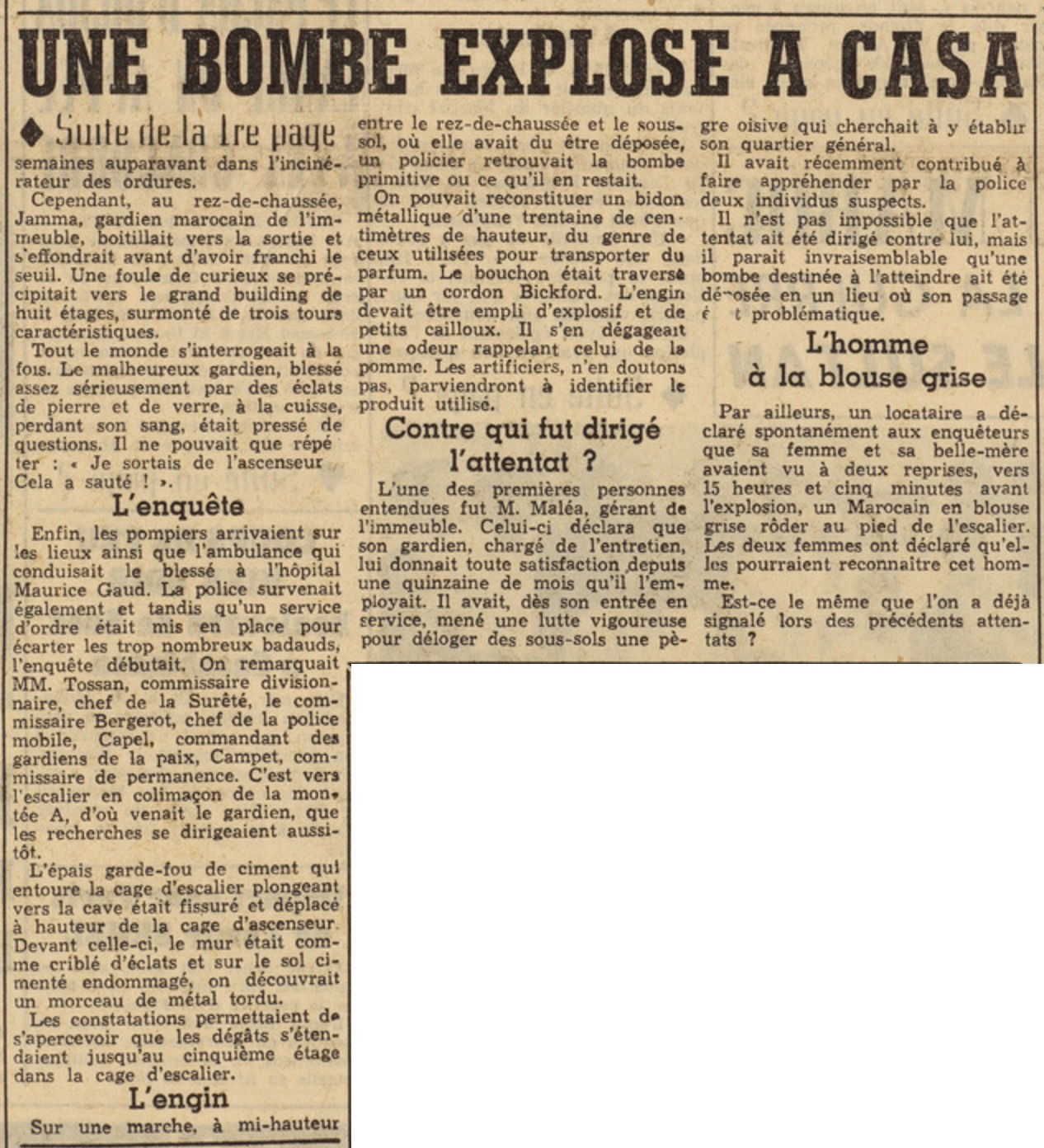
In the building's archive there is a press cutting. It tells how, on Monday 21 September 1953, at 6.40 p.m., a bomb exploded in the stairwell of Staircase A, injuring the building's Moroccan caretaker.
The fragment carries neither the name of the newspaper nor the date, and this page first dated it to 1952. The Casablanca press digitised on Gallica settled the question: it is Le Petit Marocain of Tuesday 22 September 1953, pages 1 and 2, and two other dailies reported the same attack that same morning. We therefore publish the document, what the other papers add, the context of autumn 1953 — and what remains to be established.

What the cutting says
The article opens with a reminder: the device in the building was not the first. The device that exploded at the “Municipaux”, the municipal services, it says, gave the signal for a series of bomb attacks that continued on boulevard de Suez, at Aïn Chock and in a Quranic school.
Then comes the scene. It is 6.40 p.m.; the Marché central district hears the blast. In the building every window is broken. Tenants come out onto the landings and reassure themselves as best they can: "A gas bottle has gone off in a kitchen!" Someone then remembers the explosion that had occurred "a few weeks earlier in the refuse incinerator" — that one in the basements of the building itself.
Jamma, the caretaker
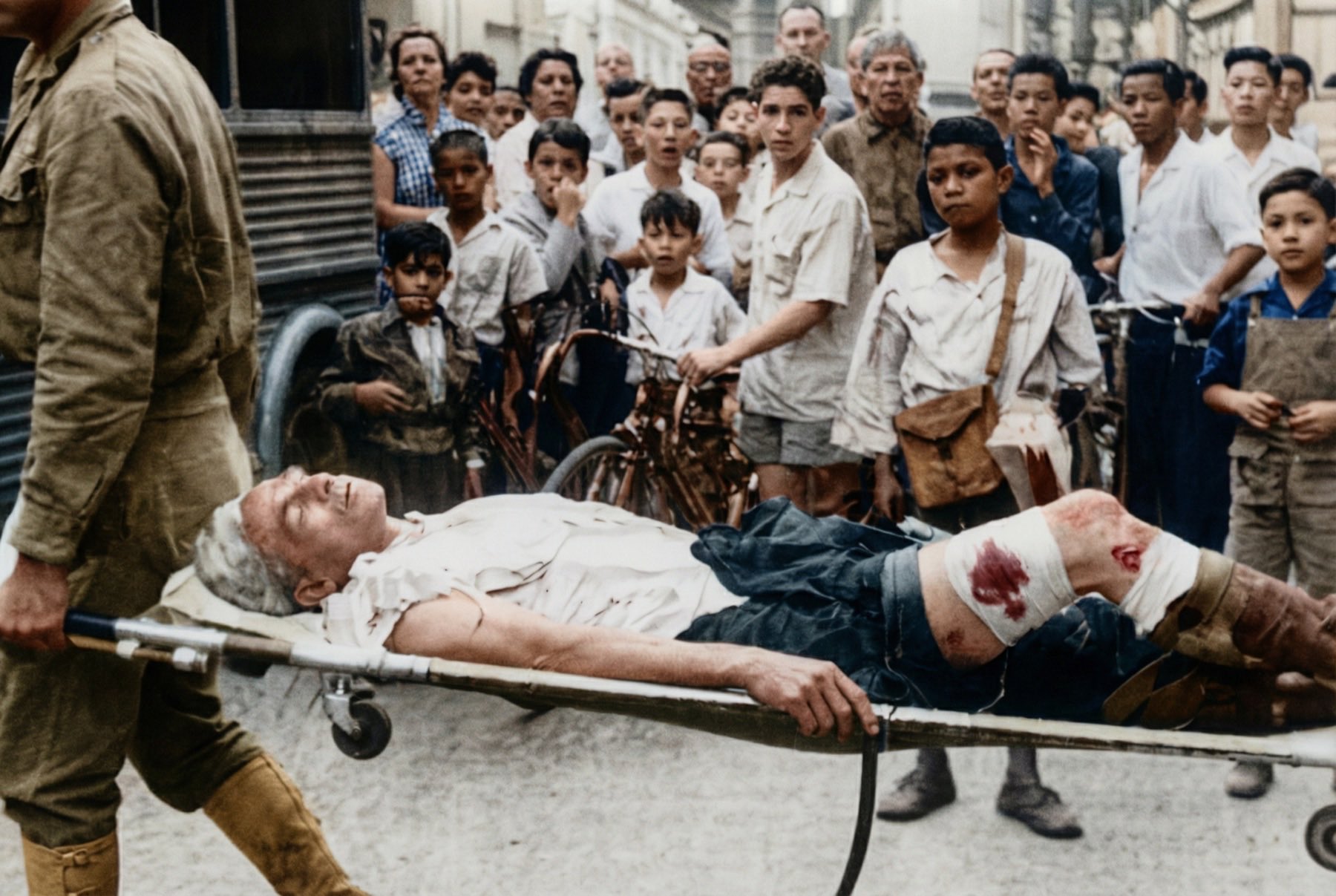
The injured man's name takes one word in the paper: Jamma, the building's Moroccan caretaker. He was stepping out of the lift on the ground floor. The text describes him limping towards the exit and collapsing before he reached the threshold, his thigh torn open by fragments of stone and glass.
A crowd rushes "towards the great eight-storey building, crowned by three distinctive towers". The injured man is pressed with questions. All he can repeat is: "I was coming out of the lift. It went off!"
The fire brigade arrives and an ambulance takes him to the Maurice Gaud hospital — the institution that would become, after its 1956 merger with the Jules Colombani hospital, the heart of today's Ibn Rochd teaching hospital.
The investigation
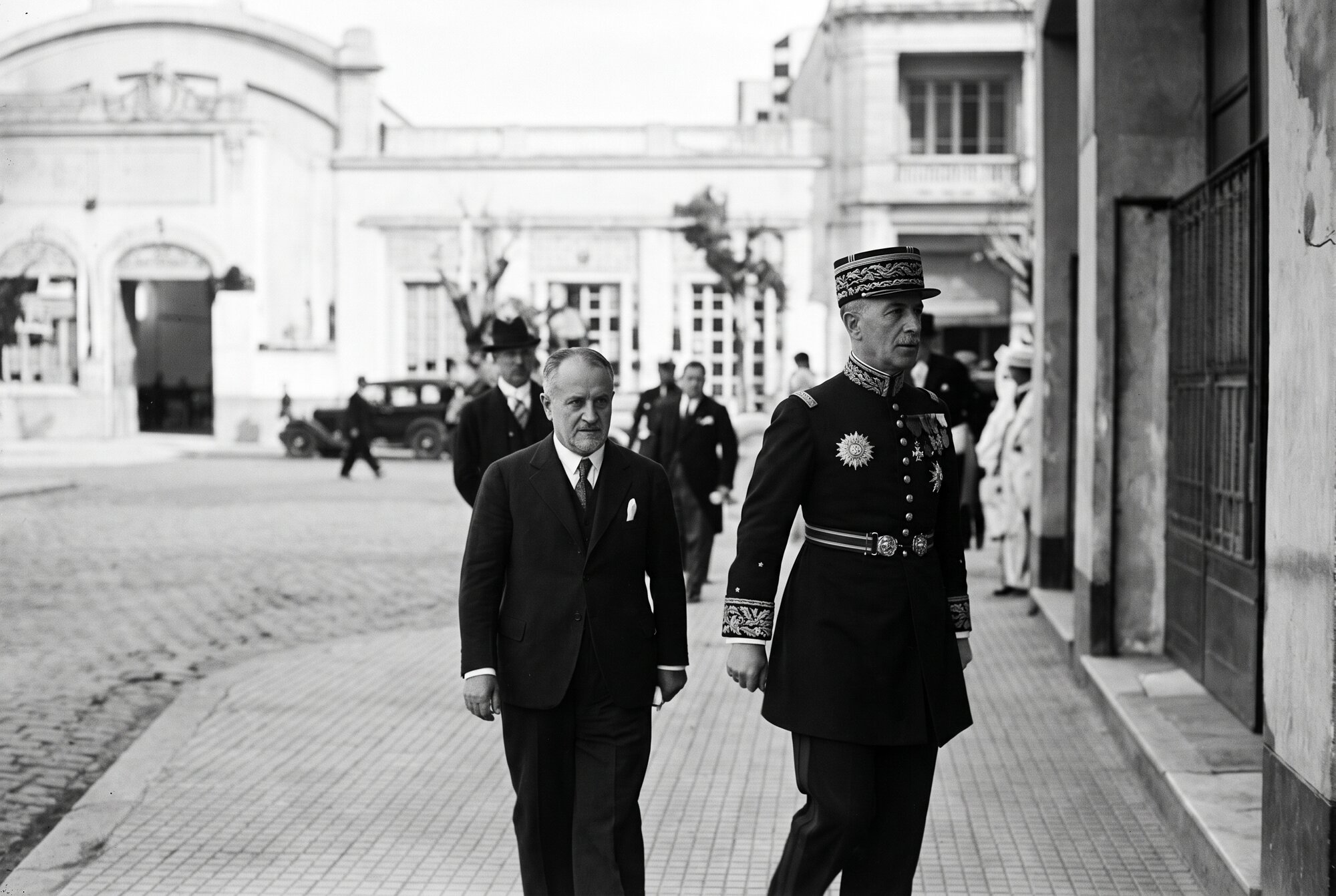
The paper names the officers sent to the scene: Tossan, divisional commissioner and head of the Sûreté; commissioner Bergerot, head of the mobile police; Capel, commander of the uniformed police; Campet, duty commissioner.
The search goes at once to “the spiral staircase of montée A, where the caretaker had come from”. The findings are precise. The thick cement rail around the stairwell running down to the cellar is cracked and displaced at the level of the lift shaft. The wall is riddled with fragments, the concrete floor damaged; a piece of twisted metal is picked up. In the stairwell the damage reaches as high as the fifth floor.
The device
On a step, halfway between the ground floor and the basement, an officer finds what is left of the bomb. The description is of something crude and precisely of its time:
"It was possible to reconstruct a metal can some thirty centimetres high, of the kind used to transport perfume. The stopper was pierced by a Bickford fuse. The device must have been filled with explosive and small pebbles. It gave off a smell recalling that of apples."
A perfume can, a slow fuse, pebbles for shrapnel. Nothing industrial: an object made by hand and left in a staircase.
Against whom?
The question occupies the end of the article, and it stays open. The building's manager, Mr Maléa, is heard first. He says the caretaker had given him full satisfaction over the fifteen months he had employed him, and above all that from his first day he had "waged a vigorous struggle to drive out of the basements an idle underworld that was seeking to set up its headquarters there". He had recently helped the police arrest two suspects.
The journalist therefore considers that the bomb may have been aimed at the caretaker himself — then sets the idea aside for a common-sense reason: the device had been left in a place his rounds did not reliably take him.
One last element remains, and it is the most unsettling. A tenant tells investigators, unprompted, that his wife and mother-in-law had twice seen — around 3 p.m., then five minutes before the explosion — a man in a grey overall loitering at the foot of the stairs. Both women say they could recognise him. The article ends on a question that was never answered: is he the same man already reported at the previous attacks?
Three newspapers, the same morning
On 22 September two other Casablanca dailies reported the attack. La Vigie marocaine, on page 4, gives the same time, “around 6.40 p.m.”, and the same police officers. It calls the caretaker “Djema” and reports what he was able to say before being taken to hospital: several men had lately tried to settle in the basements and had come up against his vigilance. A woman tenant says she saw a Moroccan loitering at the foot of the stairs five minutes before the explosion.
Maroc-Presse carries the story on its front page, with another time — “around 5.45 p.m.” — and another mechanism: the device, “of local manufacture”, went off in the lift shaft just as the car reached the ground floor, probably crushing it. The injured man, “Si Djema”, is only “slightly” hurt.
The time, the door number — 18 for Le Petit Marocain, 16 for the other two —, the spelling of the name, the seriousness of the wound: on these details the papers differ. On the essentials they say the same thing.
What followed
On 1 October Le Petit Marocain listed the cases awaiting the anti-terrorist squad of the Casablanca police — nine men, four of them Moroccan inspectors: the bombs at the Municipaux, at Aïn-Chok, at Dr Diouri's, on place Administrative, at the homes of two muezzins, “at the Immeuble Assayag”, and a series of armed attacks on shopkeepers, a newspaper editor and a police inspector. “In all these cases, it is one and the same organisation,” the paper asserted, without naming it.
On 21 October Maroc-Presse described a new bomb, a five-litre petrol can packed with powder, earth and scraps of iron, which had just exploded in the corridor of a building on rue Burger. It “resembles”, the paper wrote, “the one that recently exploded in the Immeuble Assayag”.
Casablanca, autumn 1953
The context, by contrast, is solidly documented. Since the Carrières Centrales riots of December 1952, which followed the assassination in Tunisia of the trade unionist Ferhat Hached, tension had not let up. On 20 August 1953 the protectorate authorities deposed Sultan Sidi Mohammed ben Youssef — the future Mohammed V — and sent him into exile; Mohammed ben Arafa was installed in his place.
Five days later, on 25 August, at 4 p.m., a device exploded in the toilets of the municipal services, in the Hôtel de ville — the one built by Marius Boyer, the Assayag's architect. “Much noise, little damage”, ran the headline in Le Petit Marocain; yet it is this explosion that the same paper would call, a month later, the “signal” for the series. On 11 September, in Rabat, Allal ben Abdallah threw himself at the new sultan's procession and was shot dead; a street that runs alongside the Assayag today bears his name. Ten days later it was the building's turn.
For the protectorate press these were “terrorist attacks”; Moroccan history sees in them the beginnings of the urban armed resistance that answered the sultan's exile. On 24 December 1953 the Marché central bomb, a few streets from the Assayag, would claim many victims. The sultan returned from exile in November 1955; Morocco became independent on 2 March 1956.
What we do not know
This must be said plainly, because it is half the interest of the document.
- Who planted the device. The press speaks of “one and the same organisation” without naming it; we do not know whether the investigation reached a conclusion, or whether a trial followed.
- The incinerator blast, “a few weeks earlier”, appears in no other newspaper we have consulted.
- What became of the caretaker, Jamma or Djema: we have found no news of him after 22 September.
- The door: 18 for Le Petit Marocain, 16 for La Vigie marocaine and Maroc-Presse. The building's known entrances on the avenue are numbers 14 and 18.
Where to look
It was the digitised press that made it possible to date the cutting: Le Petit Marocain, La Vigie marocaine and Maroc-Presse can be read on Gallica, day by day. What comes next lies in the protectorate archives held at the Diplomatic Archives Centre in Nantes: the Casablanca Sûreté reports for the autumn of 1953 should say what became of the investigation.
If you know what became of Jamma, if a grandparent spoke to you of that evening — write to us. This page exists to be completed.
A note on the address
One detail of the cutting deserves attention: the paper places the explosion "in the Immeuble Assayag, at no. 18 avenue Poeymirau". Two pieces of information sit there. The street then bore the name of General Poeymirau — it is today's rue Hassan Seghir. And number 18 is indeed one of the building's two entrances, the other being number 14: that is where the address 1418 on today's official documents comes from. The visits page sets this out.
The vocabulary has shifted too. The paper writes "la montée A", the word Casablancais used in 1953. In the building itself it has always been l'Escalier A, and that is the form we keep here.
Finally, the journalist's phrase — "the great eight-storey building, crowned by three distinctive towers" — matches exactly what is known of the building: above the shops, six storeys of flats, a seventh of studios, an eighth of garçonnières, laundries and maids’ rooms, then, in the towers, the duplexes of the top two levels. Already in 1953, the floors were counted as they are today.
Sources: Le Petit Marocain, 22 September 1953, pp. 1–2 (the article from which the cutting in the building's archive comes), 26 and 27 August 1953 (the Municipaux device), 1 October 1953, p. 5; La Vigie marocaine, 22 September 1953, p. 4; Maroc-Presse, 22 September 1953, p. 1, and 21 October 1953, p. 3 — gallica.bnf.fr / Bibliothèque nationale de France; for the context: work on the Carrières Centrales riots of December 1952, on the deposition of Sultan Sidi Mohammed ben Youssef and on the urban armed resistance of 1953–1955; the record of the Maurice Gaud hospital, now the Ibn Rochd teaching hospital. The colourised photograph is a modern treatment of the black-and-white press print.


💬 Comments
No comments yet. Be the first!