
The Immeuble Assayag cannot be understood on its own. Around its three towers, within a few streets, Casablanca tells twenty years of architecture, from the Central Market of 1917 to the town hall of 1937. This walk links nine stops on foot, each told at greater length in our articles.
Start: in front of the Assayag, on the corner of boulevard Hassan Seghir and rue Allal Ben Abdellah (tram: Marché Central stop). Finish: rue d’Alger, near the Sacré-Cœur cathedral. Distance: about 4 km. Time: two hours at an easy pace.
The buildings along the way are lived in or in use: admire them from the street, discreetly. The Assayag itself opens its doors only for cultural events (see Visits, Location & Access).
- The Assayag and the Lévy et Charbon building
- The old rue de l’Horloge and the Central Market
- The Glaoui building and its passage
- Place des Nations Unies and the clock tower
- The old medina, through Bab Marrakech
- Place du 16-Novembre: the Bendahan building
- Place Mohammed V: Boyer’s town hall
- Les Studios, Boyer’s own building
- The hôtels particuliers of the rue d’Alger
- Extra: Derb Omar
1. The Assayag and the Lévy et Charbon building
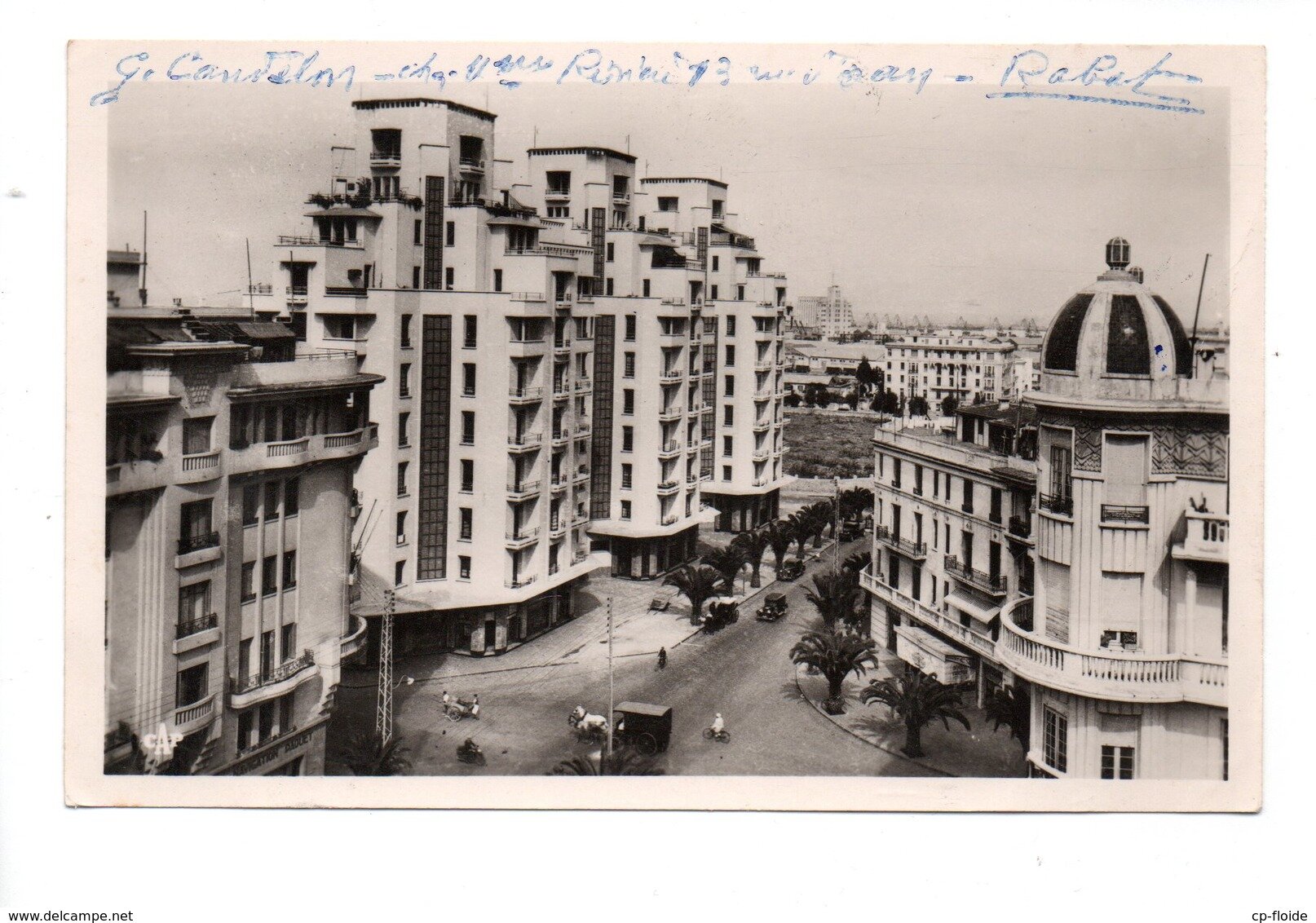
Begin at the foot of the three towers by Marius Boyer, built from 1930 to 1932. Look up: the arcades at street level, the three blocks joined at the seventh floor, then the stepped terraces rising to the duplexes of the two top levels. On rue Allal Ben Abdellah, one of the two ramps of the 1930 underground garage still opens onto the street.
Close by, the Lévy et Charbon building (Ignacio Sansone and Paul Busuttil, 1929) crowns its corners with domes of brown and blue zellige. A postcard from around 1932 already shows the two neighbours side by side.
Further reading: the history of the building · why three towers? · the 1930 garage
2. The old rue de l’Horloge and the Central Market
Follow rue Allal Ben Abdellah westwards: this is the old rue de l’Horloge, older than the great boulevards. In 1915 Maître Favrot was already calling it “lame and ill-conceived” and demanding a proper thoroughfare; that would be the boulevard de la Gare, today’s boulevard Mohammed V, which runs parallel.
On your left stretches the back of the Central Market, built from 1917 to 1920 by the architecture department headed by Pierre Bousquet. A two-minute detour leads to its main façade on the boulevard: close by stands the Martinet building (1919), also by Bousquet, and opposite, the imposing Bessonneau building, the Hotel Lincoln.
Further reading: the rue de l’Horloge · the neighbours of the Assayag
3. The Glaoui building and its passage
At the end of the street, between rue Brahim El Amraoui and boulevard Mohammed V, stands the building that Boyer and Jean Balois raised for Thami El Glaoui, Pasha of Marrakech — in 1928 according to Cohen and Eleb. Marble columns, brick arches, turrets housing the two-storey living rooms of the fifth-floor flats: a composition that would for a time become Boyer’s signature.
At the heart of the block opens the city’s first building passage, roofed with glass pavers and punctuated by rotundas. It links the street to the boulevard: walk through it, then make for the nearby square.
Further reading: Marius Boyer, a Casablanca itinerary
4. Place des Nations Unies and the clock tower
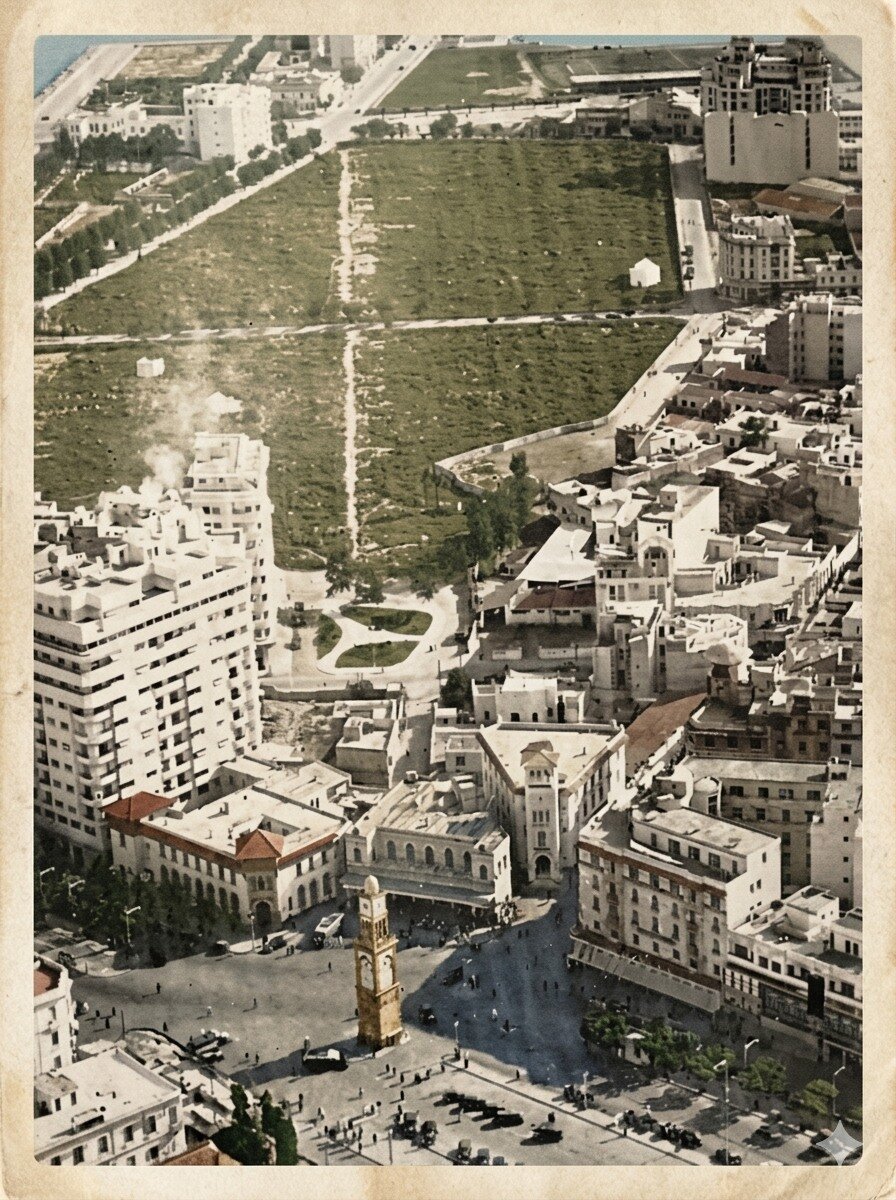
This is the former place de France, laid out by Henri Prost in 1915 between the medina and the new town. To the north, against the old town, rises the clock tower from which the rue de l’Horloge most likely took its name: built in 1908 and demolished in 1948, it was rebuilt in 1994. A few steps away stands the Hotel Excelsior.
Two buildings of the 1930s hold the square. Socifrance (Erwin Hinnen, 1935) lines up three long white bands in a manner close to the Bauhaus, far from both neoclassicism and Art Deco. Pierre Jabin’s Moretti-Milone building (1934–1935), with its eleven storeys, was for a long time the only one on the square to rise above the rooftops. The edge of the square was also home to Boyer’s Vox cinema, one of the largest in Africa, demolished in the 1970s.
Further reading: the neighbours of the Assayag · the rue de l’Horloge
5. The old medina, through Bab Marrakech
Walk west along avenue des Forces Armées Royales, then along boulevard Tahar El Alaoui to Bab Marrakech. Behind the walls begins the Casablanca of before 1907, which fitted into some fifty hectares: twenty-five thousand inhabitants, consulates, five synagogues, a Spanish church. Its façades, pierced with windows and turned towards the street, surprise anyone who knows the medinas of the interior; from the early twentieth century neo-Moorish, Art Nouveau and Art Deco stand side by side here — the rough draft of the new town.
Take a few steps along its lanes, then head back to Place des Nations Unies.
Further reading: the old medina, neighbour to the Assayag
6. Place du 16-Novembre: the Bendahan building
From the square, pedestrian streets lead in a few steps to place du 16-Novembre. Here, in 1935, Edmond Brion signed the Bendahan building on an almost triangular plot: having just parted from his partner Cadet, he adopted a pared-down manner, without superfluous ornament. Its client, Haim Bendahan, belonged to the same generation of builders as Moses Assayag.
Further reading: the Jewish commissioning clients of Casablanca
7. Place Mohammed V: Boyer’s town hall
Walk down avenue Hassan II to the former administrative square, today’s place Mohammed V, conceived within Henri Prost’s plan. Around the esplanade: the law courts, Edmond Brion’s Banque du Maroc (1937) and, above all, the town hall, entrusted to Boyer after the 1927 competition and inaugurated in 1937 — today the wilaya. Its fifty-metre clock tower plays the part of a minaret of modernity, its silhouette recalls the Doge’s Palace in Venice, and its decoration blends Arab-Andalusian art with Art Deco. Inside, on either side of the main staircase, two large compositions by Jacques Majorelle face each other: the “Moussem” and “L’Haouache”.
Further reading: the administrative square
8. Les Studios, Boyer’s own building
Continue along avenue Hassan II to the corner of rue Omar Slaoui. In 1935 Boyer built here a block that he owned himself, introducing a formula new to Casablanca: the two-storey flat, for single people and childless couples. The double height can be read on the façade, where windows and loggias are grouped in fours under a single sunshade; at the corner, the building takes on the look of an ocean liner. Boyer had already tried out the idea with the terraced garçonnières on the Assayag’s eighth floor.
Further reading: Casablanca, city of bachelors
9. The hôtels particuliers of the rue d’Alger
The last stop lies along the Arab League Park: rue d’Alger, near the Sacré-Cœur cathedral. In the 1920s and 1930s the most sumptuous houses of the district went up here. In 1930 Boyer signed town houses here in which finely carved stone and plaster chiselled with plant motifs speak of the craftsmen’s hands: the other face of the architect of the towers, in the very year of the Assayag.
Further reading: the hôtels particuliers of the rue d’Alger
Extra: Derb Omar
Before or after the walk, less than ten minutes on foot southwards along boulevard Hassan Seghir take you from the Assayag to Derb Omar, the great wholesale quarter, born in the 1930s of the same port boom as the building. Art Deco façades on one side, the bustling market on the other: two faces of the same prosperity.
Further reading: Derb Omar, the merchants’ quarter
Sources: Jean-Louis Cohen and Monique Eleb, “Casablanca. Mythes et figures d’une aventure urbaine”, Hazan; Wikipedia, “Marché central de Casablanca”, “Place des Nations-Unies (Casablanca)” and “Cinema Vox (Casablanca)”; Mutual Heritage (University of Tours), “Immeuble Les Studios” record. Route and map: data © OpenStreetMap contributors.