Ask any Moroccan where you buy “wholesale” and the answer comes in two words: Derb Omar. Less well known is that this legendary trading quarter was born at the same moment as the Immeuble Assayag, a few hundred metres from its arcades, and for the same reasons. Boulevard Hassan Seghir, where our three towers stand, marks its edge: maps and street directories do in fact attach part of the boulevard to the quarter. To tell the story of Derb Omar is to tell the story of the world in which the Assayag grew up.
The 1930s: the port makes the quarter
It all begins with the port. Between the wars Casablanca became the gateway for Morocco’s goods, and importers went looking for warehouses and trading offices as close to the quays as possible. The land just behind the medina — between what is now place des Nations unies and the roads running south — filled with shops, depots and immeubles de rapport (speculative blocks of flats built to let). From the 1930s onwards Jewish and European merchants settled there; the quarter, still without a name, became the port’s back shop.
This is exactly the movement that, from the mellah to the towers, was carrying the city’s great Jewish families in the same years: out of the old medina, build modern, trade big. Moses Assayag entrusted his three towers to Marius Boyer in 1930; his neighbours put their money into shops and warehouses. Two faces of the same prosperity.
Omar Tassi, the egg seller who gave the quarter its name
The quarter’s name comes from neither a pasha nor a saint, but from a trader. The Moroccan business press tells the story of the rise of Omar Tassi (spelled Tissir in some sources): he started out selling eggs and built one business on top of another until, by the 1960s, he was one of the most powerful men in Moroccan commerce. The derb — the lane, the passage — that bore his name ended up giving its name to the whole quarter. A very Casablanca trajectory: this is a city that has always told its own story through its self-made men.
1947–1948: the Fassis and the Soussis take over
After the war a second wave transformed the quarter. From 1947–1948 Moroccan traders — the great families of Fez first, then the merchants of the Souss — joined and then gradually replaced the Jewish and European houses. Derb Omar became what it has remained ever since: the buying house of the entire country, the place where every shopkeeper in Morocco comes to fill his lorry.
That handover accelerated through the 1950s and 1960s, as departures drained Casablanca’s Jewish community of its lifeblood. The names above the shopfronts changed; the trade did not: wholesale, semi-wholesale, import.
The quarter today: 2,300 businesses
A century on, Derb Omar has lost nothing of its calling. Surveys by the business press count more than 2,300 traders there — some 835 wholesalers, 700 semi-wholesalers and 770 retailers — and around ten thousand jobs. Fabrics, hardware and household goods, domestic appliances, supplies: whole streets each given over to a single line of merchandise, pavements cluttered with bales, sack trucks weaving between the cars. The quarter has its crises — competition from the Chinese markets, the Covid years — but it remains, in La Vie éco’s phrase, “the true heart of the Moroccan economy”.
What Derb Omar tells us about the Assayag
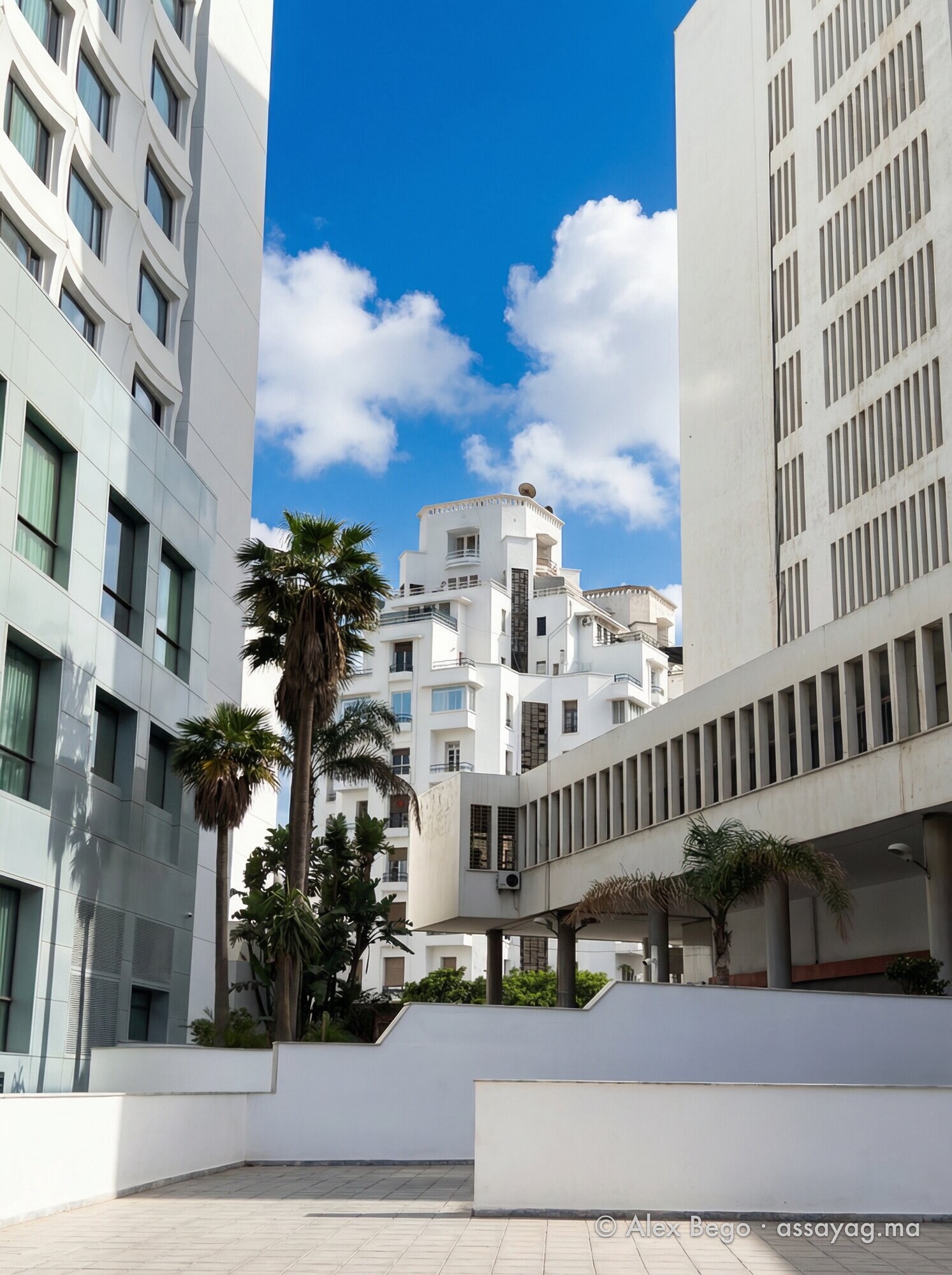
For the visitor who comes to see the architecture, the contrast is startling: on one side the Art Deco façades of the centre, on the other the merchants’ hive. In reality it is one and the same world. The 1930s speculative block of flats — of which the Assayag is the masterpiece — is a product of trade: the upper floors housed the families whom the shops below kept alive. The neighbouring blocks on the boulevard held shops and trading offices at street level; above them, modern flats with a lift and, on the roofs, the communal laundry rooms.
To walk today from boulevard Hassan Seghir towards Derb Omar is to retrace in ten minutes the route that linked the money of trade to the stone of the architects. Without the port, no Derb Omar; without Derb Omar and its merchant fortunes, no commissions for Marius Boyer and his colleagues. The noisy quarter and the elegant tower are two sides of the same coin.
Frequently asked questions
Where is Derb Omar in Casablanca?
Right in the centre, behind the old medina and immediately next to the port — boulevard Hassan Seghir, where the Immeuble Assayag stands, marks its north-eastern edge. It is a short walk from place des Nations unies.
Why is the quarter called Derb Omar?
After Omar Tassi, a trader who started with nothing — an egg seller, by tradition — and became one of the great businessmen of 1960s Morocco. The passage, the derb, that bore his name gave its name to the whole quarter.
What is there in Derb Omar today?
Morocco’s biggest wholesale and semi-wholesale market: more than 2,300 businesses — fabrics, hardware and household goods, home equipment, supplies — supplying shopkeepers across the whole country.
What is the connection between Derb Omar and the Immeuble Assayag?
Geography and history: the building stands on boulevard Hassan Seghir, on the edge of the quarter, and both were born of the same commercial boom of the 1930s, when the port of Casablanca was drawing in traders and builders alike.
Sources: Médias24, “Derb Omar, ce quartier marchand qui fait plier les gouvernements” (2019); La Vie éco, “Derb Omar, le véritable cœur de l’économie marocaine”; Economie&Entreprises (2016).

💬 Comments
No comments yet. Be the first!