
To understand what the Immeuble Assayag represents, one has to look at where the man who commissioned it came from — and at what it meant, in Casablanca, simply to build upwards.
An old community, a new city
The Jewish presence in Casablanca goes hand in hand with the rebirth of the city. There were about a hundred and fifty of them in 1832; there would be close on five thousand by 1900 — roughly a quarter of the population. Many came from Mogador, Azemmour or Rabat, drawn by the same commercial boom that took the town from five hundred inhabitants around 1850 to more than twenty thousand in 1900.
As in the other Moroccan towns, they lived in a quarter of their own within the medina: the mellah, the walled Jewish quarter of a Moroccan city. The children studied there in the Jewish elementary schools, the hadarim. In matters of personal status the community came under its own rabbis and Mosaic law; for everything else it depended on the caïd or the cadi.
The mellah and its limits
The quarter operated under the regime of the dhimma, which laid down precise rules. Jewish houses were not to rise higher than those of Muslims. Synagogues had to remain lower than mosques. And one could not own land beyond one's own dwelling.
It is worth weighing what that last clause means: it forbids, quite literally, becoming a landowner. Yet it is precisely through the ownership of land that a city is built. These constraints shaped an urban fabric of extreme density, and in the 1920s the sanitary condition of the quarter worried the authorities, who ordered partial demolitions.
The protégés: a breach in the system
One mechanism, however, made it possible to get round these limits in part: consular protection. The treaties concluded with the trading powers from the middle of the eighteenth century onwards exempted brokers in the service of European consuls and merchants from taxes and corvée labour. The Franco-Moroccan treaty of 1767 already set it down in black and white.
The status, which could be passed on to the family, spread widely: in 1869 the French merchants of Casablanca alone counted twenty-two protégés and seventy-five sharecroppers holding certificates. In 1864 the intervention of Moses Montefiore secured additional guarantees for Moroccan Jews. Some, after a stay in Gibraltar or Oran, even came back with a British or French passport.
This system nourished the emergence of a Moroccan bourgeoisie — while also widening, it must be admitted, the inequalities between those who benefited from it and those who were excluded from it.
The move to the ville nouvelle
It was in the 1920s that the movement gathered pace: Jewish families left the mellah for the ville nouvelle, the European-planned new town laid out beyond the medina. Many settled in the Lusitania district, to the south-west, where Henri Prost — author of the development plan approved in 1917 — widened the streets; the whole would be cited as a successful example of town planning.
The change was not only geographical, it was legal and mental. In the ville nouvelle one could acquire land, build freely, and build to whatever height the regulations allowed — which now meant very high indeed.
Builders of the ville nouvelle
The result can still be read in the centre of Casablanca. Jewish owners became one of the principal landholding groups there, and the buildings often bear their names: Lévy et Bendayan, whose block Marius Boyer designed in 1928; Haim Bendahan, for whom Edmond Brion raised in 1935 an ensemble we have met among the neighbours of the Assayag; the Benzaken, Coriat, Ettedgui and Tolédano families, who turned to the Suraqui brothers.
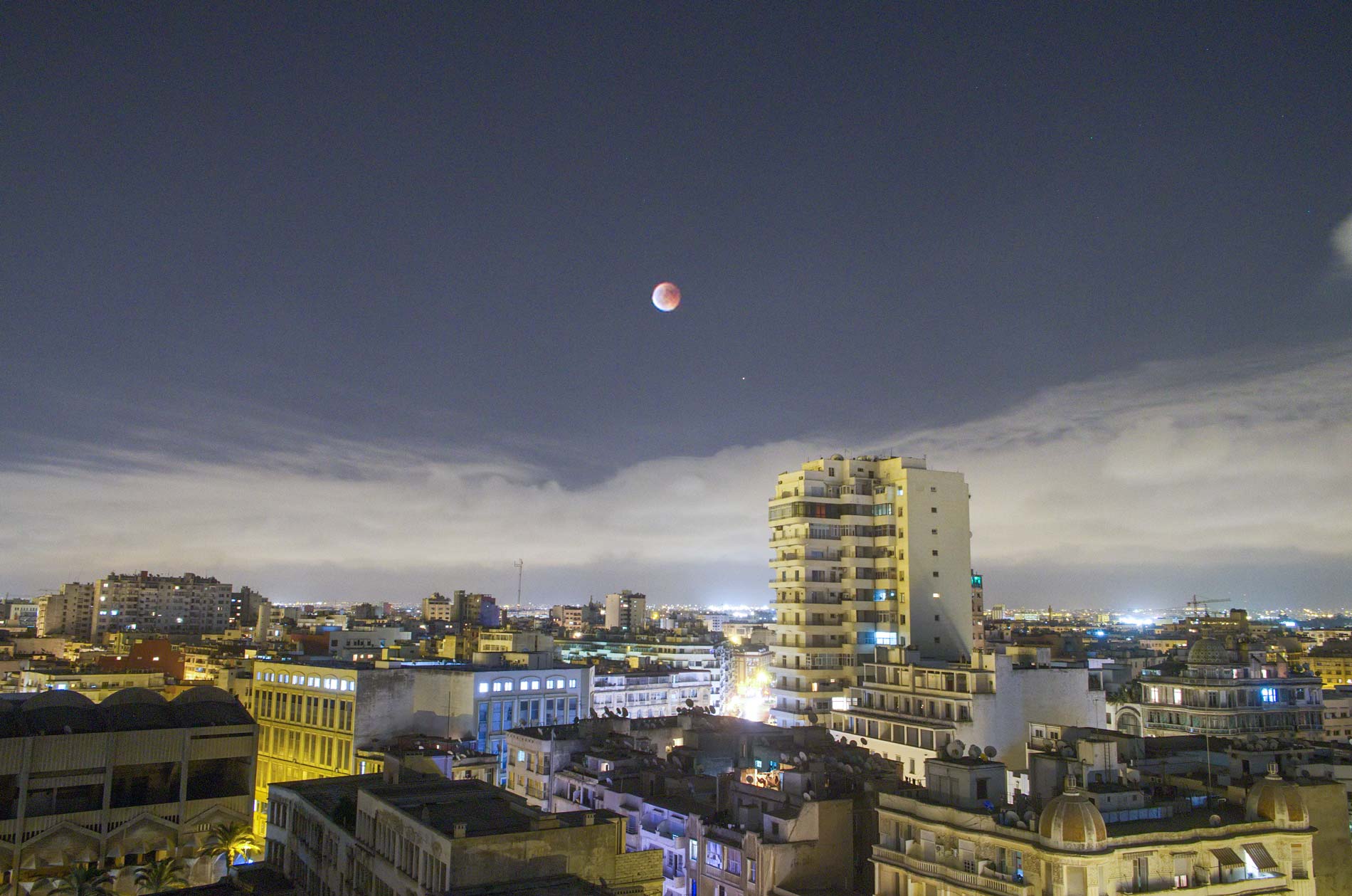
And, on boulevard Hassan Seghir, Moses Assayag, whose block rises ten storeys above its shops — six floors of flats, a floor of studios, a floor of garçonnières and laundries, two levels of terraced duplexes — where, a generation earlier, the height of his house had been regulated by the status of his community.
A community, a city
The figures tell the scale of it. At the 1931 census Casablanca had some 160,000 inhabitants, among them about 20,000 recorded Moroccan Jews. By 1952 the community had reached close on 75,000 people — a tenth of the city. In 1960, 45% of the Jews of Morocco lived in Casablanca.
That presence left an architecture behind it: schools of the Alliance israélite universelle, synagogues, housing schemes, and those blocks in the centre whose Art Deco façades make up the identity of the city today. The Assayag is one of the most visible witnesses to it — and on this site we go on telling its story.
Frequently asked questions
What was the mellah?
The Jewish quarter of the medina. In Casablanca it was assigned by Sultan Moulay Slimane at the beginning of the nineteenth century.
What rules limited building in the mellah?
Under the regime of the dhimma, Jewish houses were not to rise higher than those of Muslims, synagogues had to remain lower than mosques, and one could not own land beyond one's own dwelling.
When did the community settle in the ville nouvelle?
From the 1920s onwards, notably in the Lusitania district, remodelled under the Henri Prost plan approved in 1917.
How many Jews lived in Casablanca?
About 150 in 1832, close on 5,000 in 1900 (a quarter of the city), some 20,000 in 1930, close on 75,000 in 1952. In 1960, 45% of the Jews of Morocco lived there.
Sources: Jean-Louis Cohen and Monique Eleb, “Casablanca. Mythes et figures d'une aventure urbaine”, Éditions Hazan; Jean-Louis Cohen, “Casablanca la juive: Public and Private Architecture 1912-1960”, Quest — CDEC Journal.


💬 Comments
No comments yet. Be the first!