
The Immeuble Assayag is not an isolated piece. The district around it forms a rare ensemble: in a few streets one can read thirty years of architecture, from the immediate post-war years to the 1950s. A walk.
1919: the Martinet building, before Art Deco
On the rue Mohammed V, the Martinet building is the work of Pierre Bousquet (1885-1954), settled in Casablanca from 1914 and active until 1952. To him we also owe the lycée Lyautey, the civil hospital and the Institut Pasteur — buildings in a simple, functional manner.
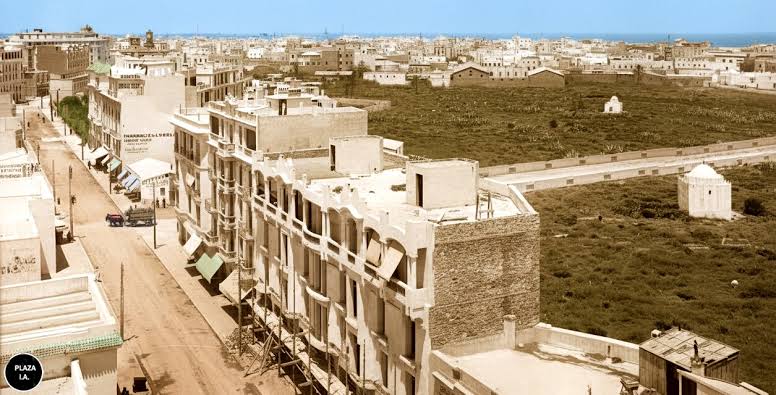
The context has to be pictured: in 1919 the city was emerging from the First World War, the cement industry had only just established itself, and building was done first of all to meet the urgent need. Art Deco would come afterwards.
1929: Charbon et Lévy
The work of Ignacio Sansone and Paul Busuttil, the building spreads three façades over a commercial ground floor surmounted by five floors of flats — the classic formula of the urban immeuble de rapport (a speculative block of flats built to let), where the shop finances the housing.
Sansone's career says a great deal about the cosmopolitanism of the city: he arrived from Tunisia in 1920, had begun as a builder before becoming an architect, and was already working with his brother-in-law Busuttil, also born in Tunis, by the late 1920s: the two names sign this building together in 1929, then the Eyraud building on the boulevard de Marseille in 1934.
1934-1935: Moretti-Milone, the vertical
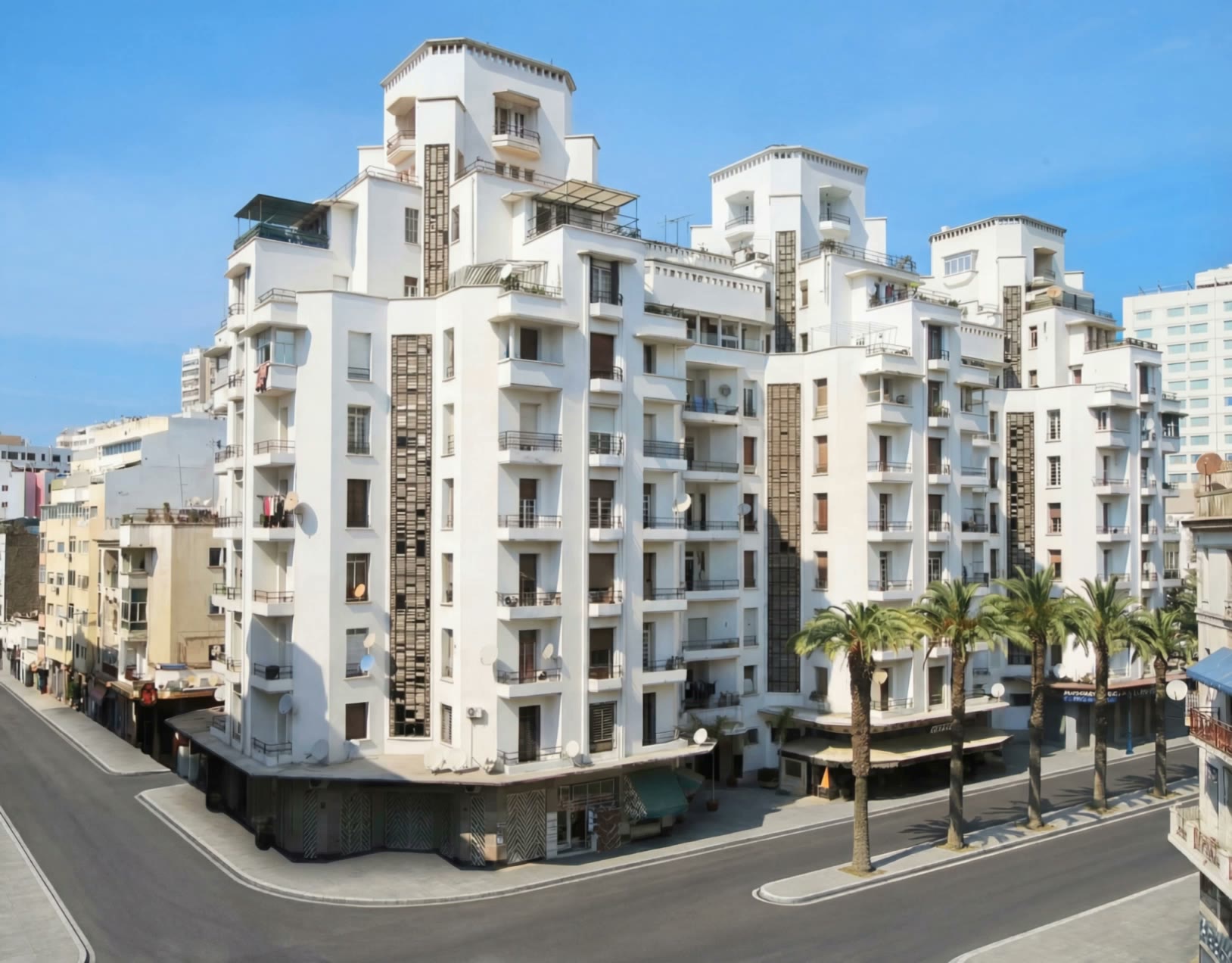
With its eleven storeys, Pierre Jabin's block long remained the only one on its square to rise above the roofs. It announces the wave of high-rise blocks begun in the 1930s at the entrance to the so-called “business” quarter — the very one that the authorities wished to link to the port by encouraging building upwards.
Jabin is no stranger to the district: to him we also owe, on the rue Kori, one of the hôtels particuliers — private town mansions — built in 1931-1932.
1935: two visions in the same year
That year, two buildings bear witness to a turning point. Socifrance, by Erwin Hinnen, introduces on what is now the place des Nations unies — then the place de France — an idiom close to the Bauhaus, with recourse neither to neoclassicism nor to the Art Deco then dominant in the centre: three long white bands set the tone.
Edmond Brion's Bendahan, for its part, marks its author's move away from ornament. Brion, who had just parted from his partner Cadet, adopts a stripped-down idiom, without superfluous decoration, on an almost triangular plot. The client who commissioned it, Haim Bendahan, belongs to the same generation of builders as Moses Assayag.
1952: the Villa Paquet, the final act
The work of Jacques Gouyon, this sixteen-storey block plays on undulating balconies that seem to float in front of the façade, carried by a system of brackets concealed behind the balustrades. Its name announces the brief: numerous services offered to the inhabitants.
Twenty years after the Assayag, the city had absorbed the vertical to the point of making it an exercise in style — but the idea of a block that is of service to its inhabitants had not changed.
Reading a district like a book
To walk from boulevard Hassan Seghir to the place des Nations unies is to cross three decades: post-war functionalism, the speculative block with its arcaded galleries, the Art Deco of the great compositions, the irruption of the Bauhaus, then the modernity of the 1950s.
Among these neighbours, the Assayag holds a particular place: that of a building that managed to be monumental without ceasing to be lived in. To be discovered in pictures in the gallery, and on foot with our Art Deco walk around the Assayag.
Frequently asked questions
Which notable buildings surround the Immeuble Assayag?
In particular the Martinet building (1919), Charbon et Lévy (1929), Moretti-Milone (1934-1935), Socifrance and Bendahan (1935) and the Villa Paquet (1952).
Which is the tallest block in the district?
The Villa Paquet, with its sixteen storeys, is taller than Moretti-Milone (eleven storeys) and the Assayag (ten).
Can these buildings be visited?
Most of them are lived-in private blocks. Some open during heritage events; the dates are announced in our news.
Source: Jean-Louis Cohen and Monique Eleb, “Casablanca. Mythes et figures d'une aventure urbaine”, Éditions Hazan.

💬 Comments
No comments yet. Be the first!