
On the plans, the Assayag Building bears the signature of Marius Boyer. But a Casablanca building around 1930 was the work of many more hands: a client, an architect from far away, a contractor who was often Italian, Moroccan master craftsmen, marble quarried in the country’s wadis, zelliges and ironwork made on the spot. Jean-Louis Cohen and Monique Eleb paint a portrait of this building world.
A city of architects
In the early 1920s, the job applications filed with the administration show the scale of it: relative to population, Casablanca had three times as many architects as Tunis and twice as many as Algiers, and the density of contractors was higher still. The first to arrive were Hippolyte Delaporte, active in the new town from 1913, and Gourdain. Marius Boyer came during the war as a lieutenant in the Engineers, with, Henri Prost noted, “a great many awards from the École des Beaux-Arts”; Auguste Cadet, first employed by the architecture services, later went into partnership with Edmond Brion and Aulier. Georges Vimort landed for the 1915 exhibition, Fougère came from Tangier, Albert Laprade arrived in 1915 and Joseph Marrast early in 1916.
Careers from everywhere
Their backgrounds could hardly be more varied. The Pertuzio brothers, born in Algeria, trained in Tunis; Pierre Jabin, Arrivetx and Gustave Cottet, also born in Algeria, studied there; the Suraqui brothers, born in Oran, had trained only as surveyors; Aldo Manassi graduated from the Milan Academy, and the Frenchman Curton trained in Berlin. In the early 1930s a more radical generation arrived, trained at the École des Beaux-Arts in Paris: Marcel Desmet, Erwin Hinnen, Georges Renaudin, Paul Perrotte. Several of their faces were published in Le Maroc en 1932: Boyer, Albert Greslin, Pierre Bousquet, Élias and Joseph Suraqui, Manassi.
These architects, Cohen and Eleb observe, were generally not heirs: often without connections in France, sometimes on the margins of the French system of recognition, they found upward mobility and concrete opportunities in Morocco, and worked in an atmosphere of freedom that shows in their successive projects. Like their Parisian colleagues, they drew both on eclecticism and on rationalism, before their discovery of the country’s old architecture reshaped their approach.
French architects, Italian contractors
The clients were Europeans who had made their fortune, the Jewish upper bourgeoisie of North Africa, Moroccan notables: they built their own villas and apartment buildings, and the custom paired a French architect with an Italian contractor. Among the firms, the historians cite Baille, Rivollet and Sidoti, Liscia, Ferrara and Selva. Many contractors, Italians such as Ferrara, the Selva brothers, Biagio, Battaglia or Pappalardo, or Frenchmen such as Baille, Gouvernet and Lorentz, had come by way of Tunisia or Algeria and already knew the climate and ways of life of the Maghreb.
A good many remarkable buildings belonged to them. The corner building on rue Lasalle, for example, was built by the contractor Pappalardo; the one Henri Couette put up for the contractor Banchi, at the corner of boulevard Foch and rue de Pont-à-Mousson, briefly held the city’s height record. At the bottom of the ladder, the poorest Spaniards and Italians of the Maârif district worked as small contractors and building workers; on the route de Rabat, around 1920, a Spanish tile depot sold faience and cement tiles.
The maâlems and concrete
These contractors were quick to recognise and use the skills of the m’allemîn, the Moroccan master craftsmen: on site, the teams mixed training and origins. Georges Vidalenc describes contractors assisted by jobbing builders and masons from the Limousin, Sicily or Valencia, and marvels at how fast Moroccan workers took up reinforced concrete: many firms employed no one else, apart from the European site foreman. But a single very good harvest, as in 1928, was enough to send the peasants back to their land; the firms, grown cautious, speeded up the mechanisation of their sites.
Technique adapted to the country. For Marcel Desmet’s Groupe Brazza (1931–1932), the frame was entirely of reinforced concrete, with outer walls in double brick: concrete stood up to the humid coastal climate better than iron, and the double wall kept out swings in temperature. The period text that presented it added, bluntly, that Moroccan labour was then paid very little.
Marble from the wadis, zelliges from Casablanca
Apart from brick and cement, mass-produced locally from the 1920s, the materials were Moroccan. Grey-veined marble from the oued Yquem and red-veined marble from the oued Akreuch lined building entrances and luxury homes. Mosaics, zelliges, glass paste and ironwork were made in Casablanca itself, and architects worked closely with mosaicists, ironworkers and cabinetmakers; a drawing of ironwork by the architect Georges Grel, from around 1932, survives, for instance. Reinforced-cement claustras, “panels of openwork material” in the words of the Casablanca decorator Kirk Lucien Coste, let through air and light.
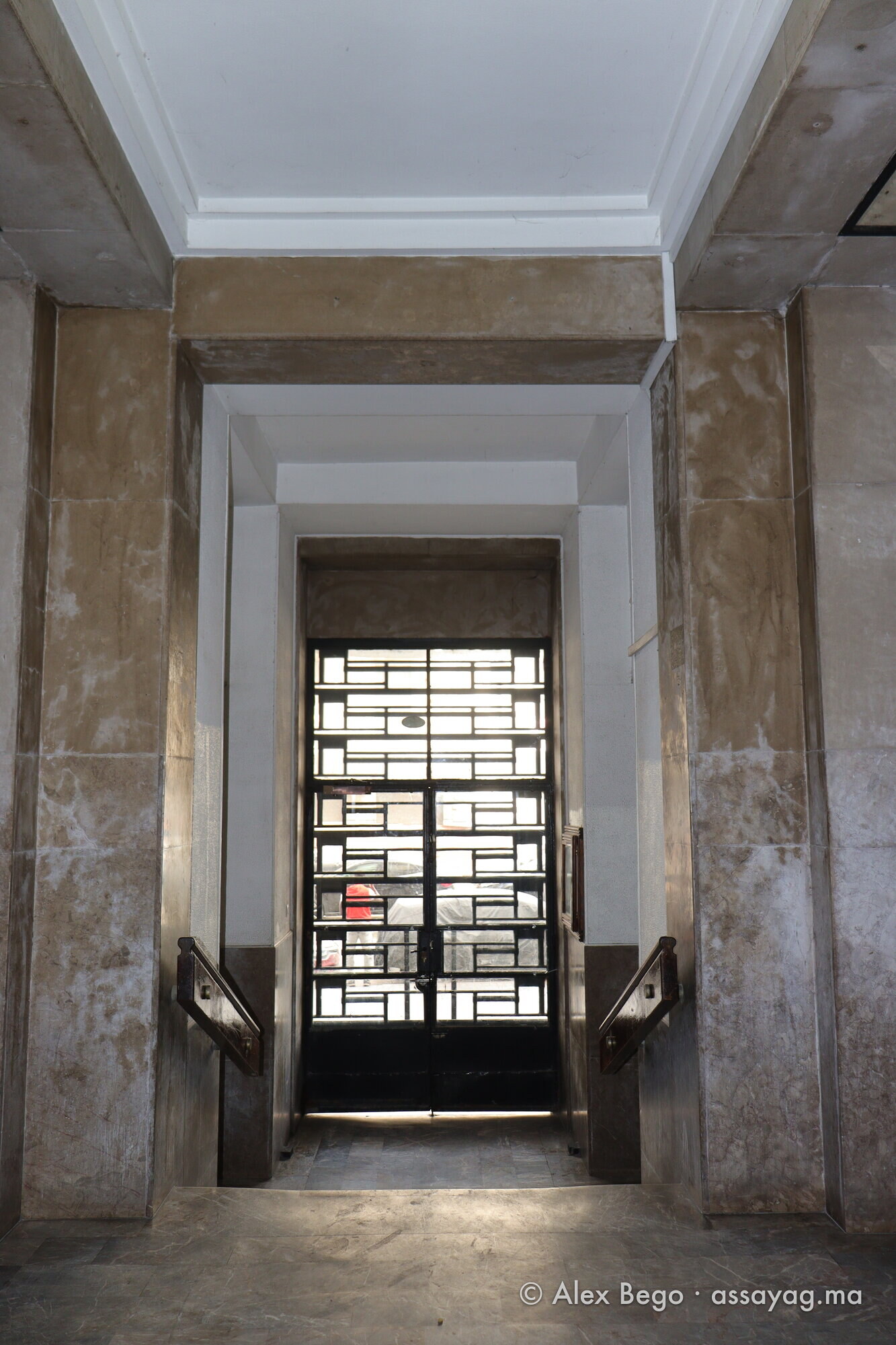
The 1930s building entrance, where all these techniques met, became a total work of art: large marble slabs alternating with bands of mosaic, granito floors edged with tiles, wrought-iron doors, in a geometric spirit often more Viennese than Parisian. The intricacy of the design told the building’s standing. And, Cohen and Eleb write, the hand of the marble workers Léglise et Maria or Liscia, and that of the Specioso brothers, art ironworkers, can be recognised there as surely as the architects’.
In the halls of the Assayag
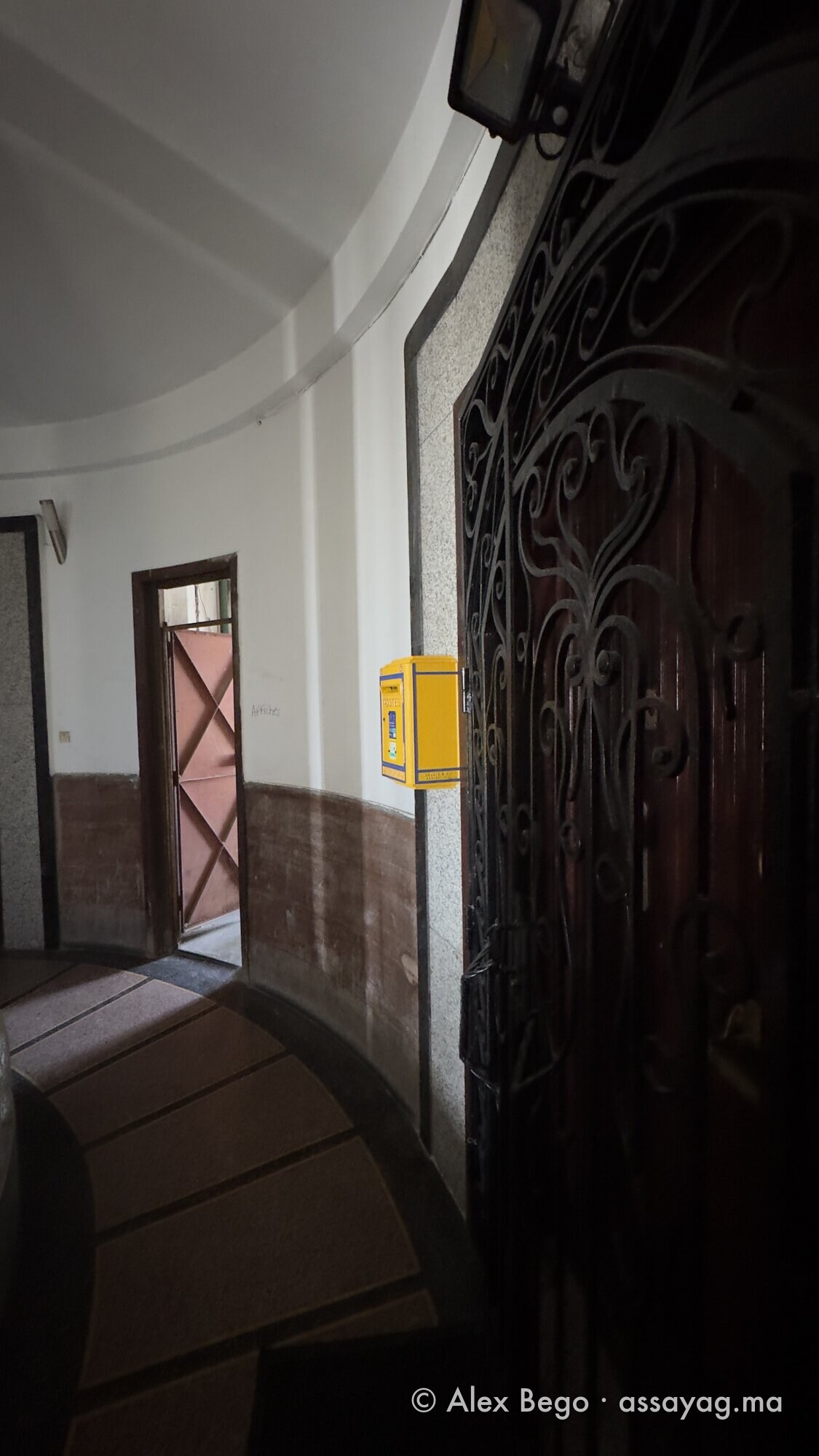
The halls of the Assayag speak this language. One enters through a door with a geometric grille framed by pilasters of ochre tiles; the vestibule keeps its large slabs of veined marble; a brown marble dado runs as far as the circular staircase; on the fifth-floor landing, the granito floor is cut by gilded metal joints that follow the curve of the wall; elsewhere, a wrought-iron door with scrolls. The names of those who cut, laid and forged these pieces are not written on the walls: an invoice, a firm’s plate or a family memory would give them back to the building. Write to us.
Frequently asked questions
Who were Casablanca’s architects in the 1920s and 1930s?
Architects with very diverse careers: Delaporte and Gourdain, the first to arrive, Marius Boyer, Auguste Cadet, Edmond Brion, Albert Laprade, Joseph Marrast, the Pertuzio brothers trained in Tunis, the Suraqui brothers born in Oran, Aldo Manassi who graduated in Milan, then, in the early 1930s, Marcel Desmet, Erwin Hinnen, Georges Renaudin and Paul Perrotte, trained at the Beaux-Arts in Paris.
Who built the buildings?
Contractors who were often Italian (Ferrara, Selva, Biagio, Battaglia, Pappalardo) or French (Baille, Gouvernet, Lorentz), who had come by way of Tunisia or Algeria, with European masons, Moroccan master craftsmen and Moroccan workers quickly trained in reinforced concrete.
Where did the marble in Casablanca’s buildings come from?
From Morocco: grey-veined marble from the oued Yquem and red-veined marble from the oued Akreuch, used in entrance halls and luxury homes; mosaics, zelliges and ironwork were made in Casablanca.
What craftsmanship can be seen in the Assayag Building?
The veined marble of the vestibule, the brown marble dado, the granito with gilded metal joints on the landings, the wrought-iron doors and the geometric grille of the entrance: the palette of Casablanca’s 1930s halls.
Sources: Jean-Louis Cohen and Monique Eleb, Casablanca. Mythes et figures d’une aventure urbaine, Hazan, pp. 88–92 and chapters “Habiter la ville nouvelle : les années 1920” and “Des arts décoratifs à la modernité”; the authors cite in particular Henri Prost (note of 3 December 1922), Georges Vidalenc, Le Maroc en 1932 and Chantiers nord-africains. Translations from the French are ours. Photographs: Alex Bego.


💬 Comments
No comments yet. Be the first!