
Beneath the Immeuble Assayag there are rooms nobody was ever meant to see. They housed the incinerator, the boiler room and the water tanks — everything that kept a ten-storey block running in the early 1930s. In May 2025, ten artists hung their work in them.
Chez Marius, or the second life of the basements
The space is named after the architect: Chez Marius, in homage to Marius Boyer. The idea came from the syndic, the managing agent appointed by the co-owners, who put it to them that plant rooms fallen out of use should be given back to the collective life of the building. The general meeting voted in favour. Since then the basements at 18, boulevard Hassan Seghir have hosted exhibitions, readings and performances, in a building listed grade A+, the highest grade in Casablanca's heritage inventory.
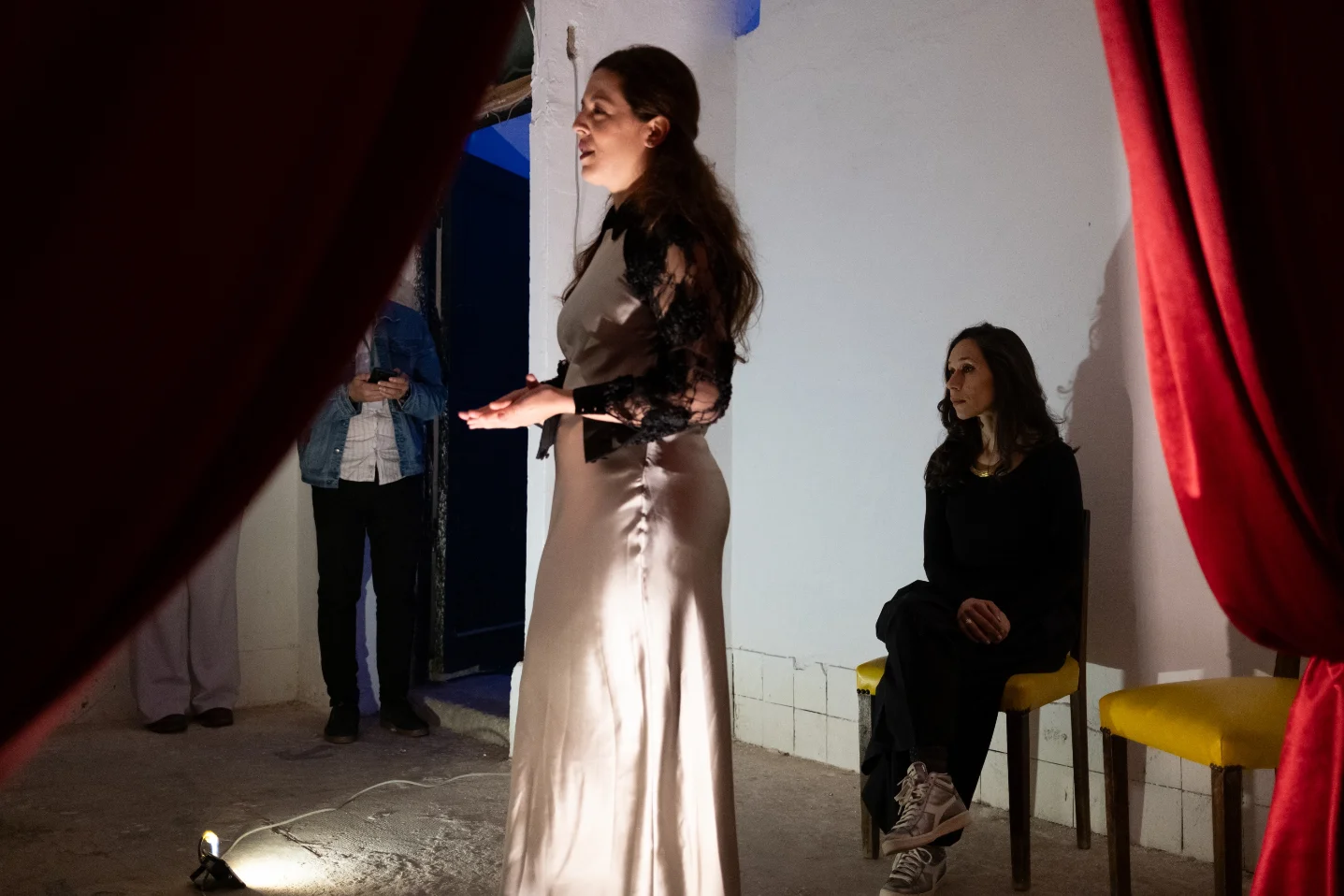
This was no first attempt. As early as 2023 the building had opened its common parts for the Journées du Patrimoine, Casablanca's annual heritage open days, on the theme of matrimoine, women's heritage: dance, theatre, visual performances and a literary café dedicated to the memory of Monique Eleb, who had died on 26 May that year.
She had not been chosen at random: Monique Eleb lived in the building. Born in Casablanca, a sociologist of housing, she divided her time between the residence and Paris, where she taught at the École nationale supérieure d'architecture Paris-Malaquais. With Jean-Louis Cohen she had devoted twelve years to the history of the city; their book remains to this day the principal written source on this building. Which is to say: the standard work on Casablanca's architecture is co-signed by a resident of the Assayag.
How did these basements become a venue? Le360’s report, filmed at the opening in May 2023, lets those who did it say so. The building manager, Pierre Pilven: the residents “voted at a general meeting” and gave “carte blanche to bring the place to life”; it was “the community of residents who contributed, through their contributions to the syndic, so that the basement could be brought up to standard”. The president of the co-owners’ board, Ahmed Idrissi Kaitouni, sets the horizon: “to restore the building as it was built in 1930” — a building which, “at ninety, has nothing to envy in what is being built today”.
Video report by Le360, May 2023 — Qods Chabâa and Khadija Sebbar. Video: Le360. In French.
“Citadelle”, three days in May
From 12 to 18 May 2025, Casamémoire, the Casablanca heritage association, was running the fourteenth edition of the Journées du Patrimoine de Casablanca. The theme could not have suited the Assayag better: “Art Deco, between heritage and modernity”, marking the centenary of the Exposition internationale des arts décoratifs held in Paris in 1925. More than fifty free events were on offer across the city.
It was in this setting that “Citadelle” was held. Guided tours on the Friday from 18:00 to 22:00, on the Saturday from 10:00 to 22:00 and on the Sunday from 10:00 to 18:00; private view on the Saturday evening. Ten artists brought together by the collective écriture automatique, with livre_moi and Casablanca Courts-Circuits:
Khalil Nemmaoui, Ilias Selfati, Hicham Matini, Badr El Hammami, Abderrahman Doukane, Hakim Benchekroun, Anass Guermouj, Mohamed Noujmi, Alexis Logié and Brahim Benkirane.
The line-up is anything but incidental. Khalil Nemmaoui, born in 1967 in the Middle Atlas and a self-taught photographer, received the Prix de la Francophonie at the Rencontres de Bamako for his series La Maison de l'Arbre. Badr El Hammami, born in 1979 and based in Marseille, has worked for years on borders, migration and memory — he has exhibited at the Museo Reina Sofía and at Manifesta 13.
Ilias Selfati comes to give a work
Born in Tangier in 1967, Ilias Selfati graduated from the Institut des beaux-arts in Tétouan in 1991, then went on to the Faculté des beaux-arts in Madrid, where he trained in printmaking under Mitsuo Miura and in painting under José Hernández. He lives and works in Tangier.
His work is held in the Saatchi & Saatchi collection in London and in that of Bank Al-Maghrib. He took part in the inaugural exhibition of the Mohammed VI Museum in 2014, in the Paris Nuit Blanche in 2015 and in the first Rabat Biennale in 2019.
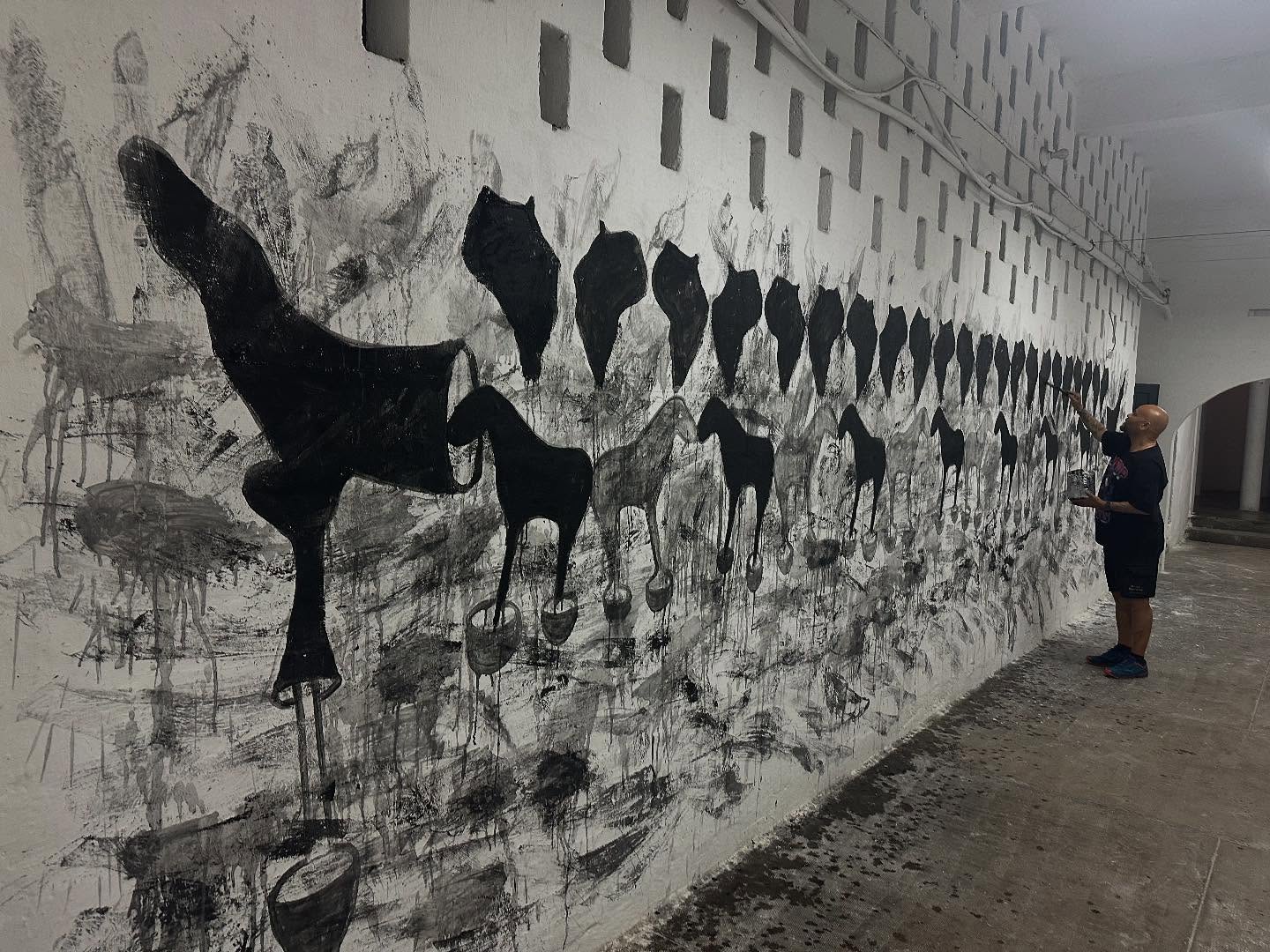
He did not come to the Assayag to hang a picture. He came to give a work to the building, painted straight onto the basement wall.
Horses with neither ears nor tail
Anyone who knows Selfati's work recognises the motif at once. Horses have been his signature for years: black silhouettes pared back to the essential, without ears or tail, born of the artist's childhood memories in the Ahfir region of northern Morocco.
His method owes as much to taking away as to adding: he builds up, then erases, until the form reaches the threshold where just enough is left for a horse to be recognised, and already too little for it still to be a representation. These are signs rather than animals.
On the wall at the Assayag the herd moves in single file. On the left, one huge beast fills the whole height; then the silhouettes shrink, close up, repeat, until they are no more than small marks at the far end of the wall. The paint runs. Beneath several of the horses, shapes like cups or buckets catch the black trails. It looks like a procession moving away.
10 May 2025
While the exhibition was being prepared, news broke. On 10 May 2025, in Basel, Koyo Kouoh died of a cancer diagnosed a few weeks earlier. She was 57.
Born in Douala in 1967 and raised in Zurich, she had founded RAW Material Company in Dakar in 2008, then from 2019 directed the Zeitz MOCAA in Cape Town, which she turned into one of the continent's major museums. In December 2024 the Venice Biennale appointed her curator of its 2026 edition: she was to become the first African woman to lead the event. Her conviction came down to a single sentence: you build your own house rather than ask to be let into someone else's.
“L'Afrique pleure”
The next day, 11 May, the collective that had brought the artists together published a photograph of the mural in progress. Selfati, moved by the grief of his hosts, had decided to dedicate the work to Koyo Kouoh. It bears a title: “L'Afrique pleure”, Africa weeps.
The message ended with a phrase that is not the artist's: “The dead are not dead”. It is the most famous line of Souffles by Birago Diop, the Senegalese poet — from the country where Koyo Kouoh had built her first institution.
Selfati and Kouoh were born in the same year, 1967.
What a building can still do
None of this was picked up by the press. “Citadelle” lasted three days and exists, to this day, only in the photographs of those who were there. That, too, is why this page has been written.
The distance travelled is worth measuring. A block of flats put up in 1930, whose basements housed a boiler room and an incinerator, becomes ninety-three years later the place where a Moroccan artist pays tribute, on a bare wall, to the curator who was to carry African art to Venice. Heritage here is not a backdrop to be visited: it is a place where something is still happening.
To go further, see Events and Culture and the gallery.
Frequently asked questions
What is “Chez Marius”?
It is the cultural space created in the basements of the Immeuble Assayag, at 18, boulevard Hassan Seghir. These rooms originally housed the building's technical plant: incinerator, heating, water tanks. The co-owners voted to open them to cultural life. The name pays tribute to the architect Marius Boyer.
When did the exhibition “Citadelle” take place?
In May 2025, during the fourteenth edition of the Journées du Patrimoine de Casablanca, organised by Casamémoire from 12 to 18 May on the theme “Art Deco, between heritage and modernity”. The exhibition brought together ten artists, with guided tours from the Friday to the Sunday and a private view on the Saturday evening.
Who is Ilias Selfati?
A Moroccan artist born in Tangier in 1967, a graduate of the fine arts schools of Tétouan and then Madrid. His stylised horses, without ears or tail, have become his signature. His work is held in the Saatchi & Saatchi collection and that of Bank Al-Maghrib, among others.
To whom is the mural dedicated?
To Koyo Kouoh, a curator born in Douala in 1967, director of the Zeitz MOCAA in Cape Town and the first African woman appointed to head the Venice Biennale, who died on 10 May 2025 in Basel. The work is entitled “L'Afrique pleure”.
Sources: the organisers' and the artists' accounts; Casamémoire, programme of the Journées du Patrimoine 2025; le360, “Un espace culturel dans les sous-sols de l'immeuble Assayag”; galerie Abla Ababou and Diptyk for the biography of Ilias Selfati.
💬 Comments
No comments yet. Be the first!