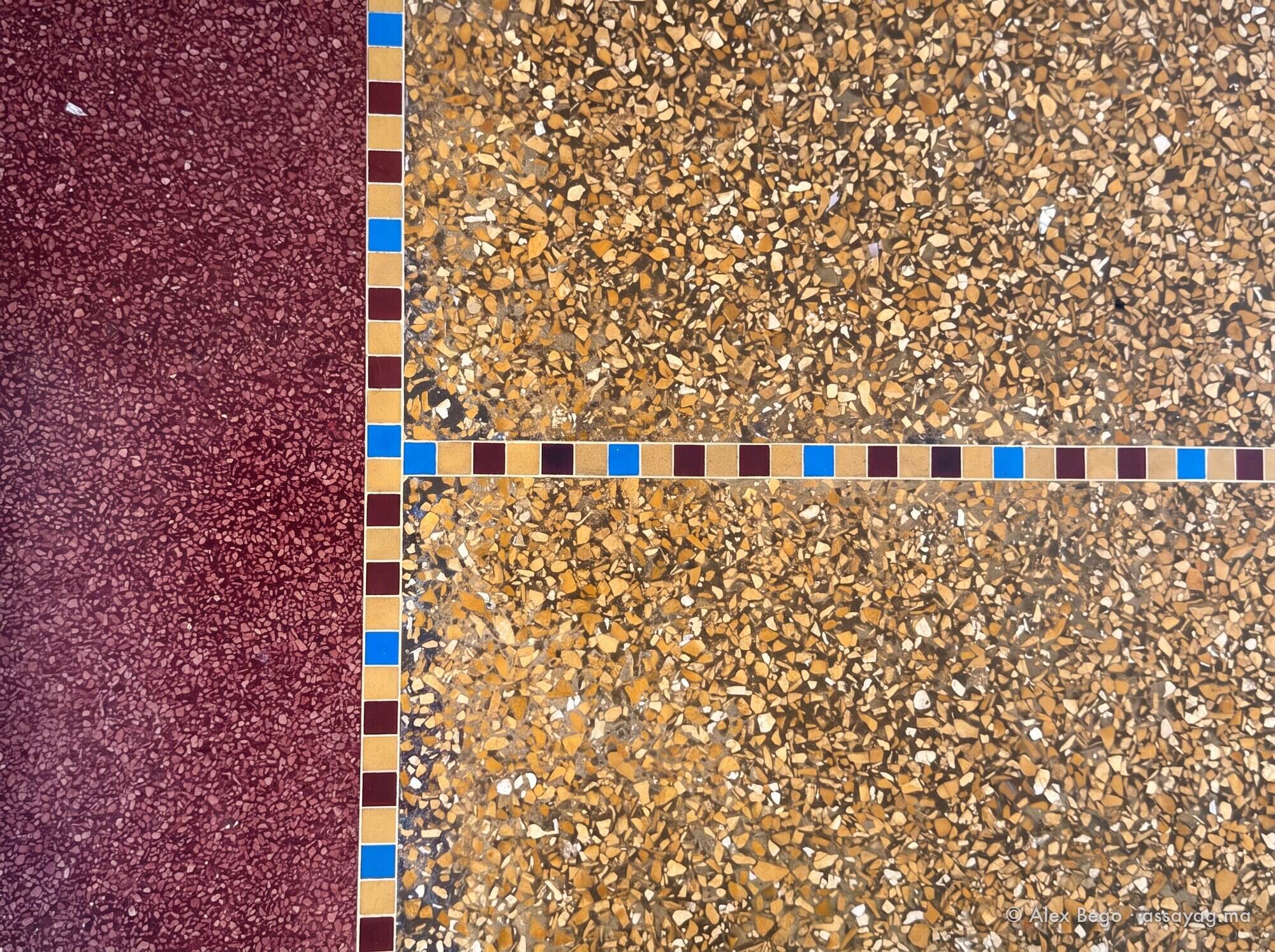

Granito is the floor of the Assayag's landings. The word is Casablanca's; elsewhere it is called terrazzo. It is a floor cast in place, in two layers: on the concrete slab, a bed of mortar; above it, one to two centimetres of tinted cement mixed with marble chips of several colours. After a few days of curing, the surface is ground with a stone, ever finer, until the chips show cleanly cut; the pores are filled with cement grout, then the floor is polished. There are no tiles: the surface is continuous, and the pattern is fixed in advance by dividers. In a terrazzo these are usually strips of brass or zinc, which keep each colour within its limits and break up the slab so that it does not crack as it dries; at the Assayag they are rows of small ceramic tesserae, yellow, blue, ochre or garnet.
The technique comes from Venice, where marble offcuts were reused in palace floors from the Renaissance onwards. Italian craftsmen spread it around the Mediterranean; between the wars, in Casablanca, it is found in most apartment buildings, from the halls to the stair treads, because it is hard-wearing, washable, without joints for dust to settle in, and because it allows decoration without applied ornament: colour and geometry are in the material itself.
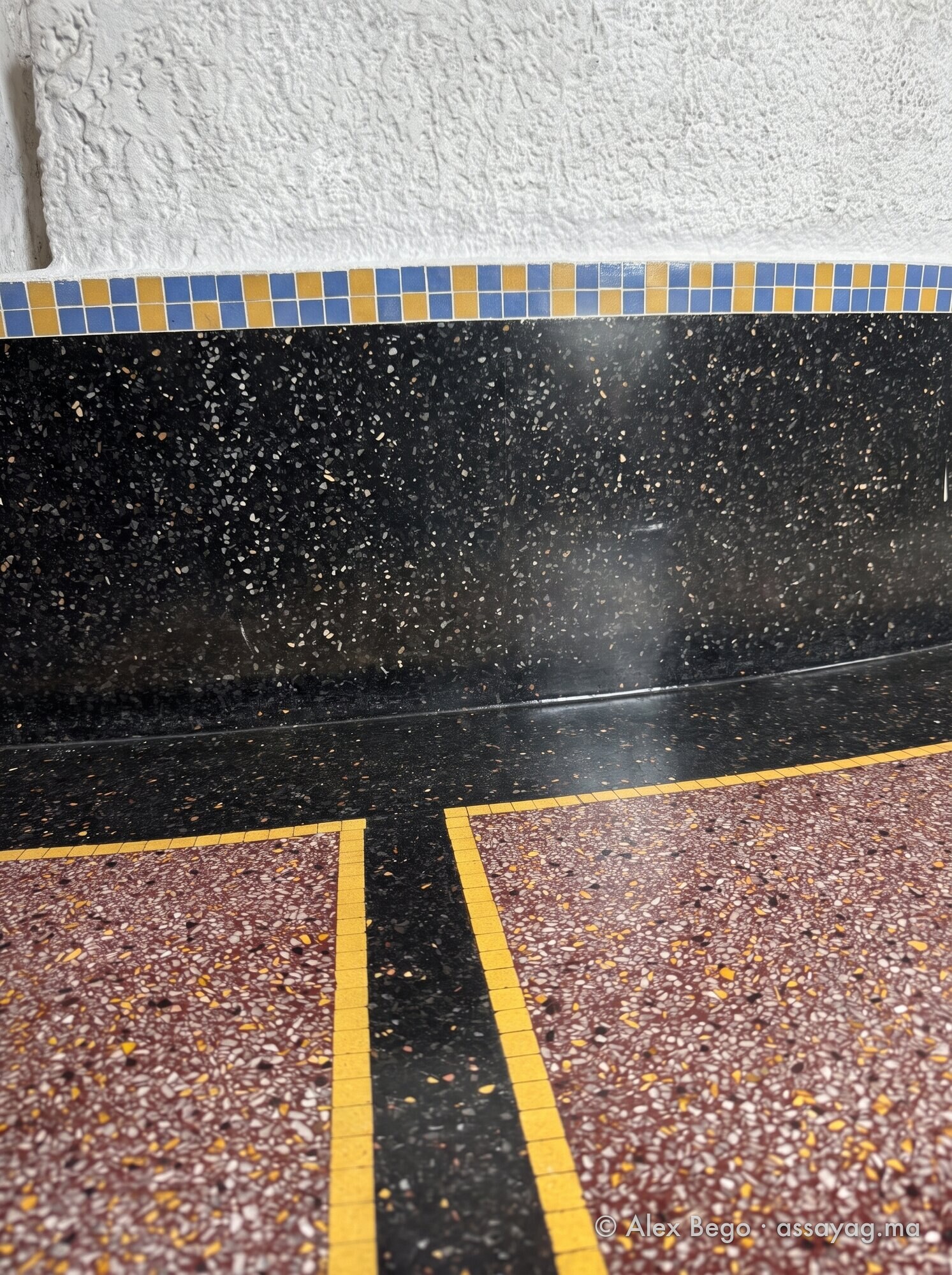
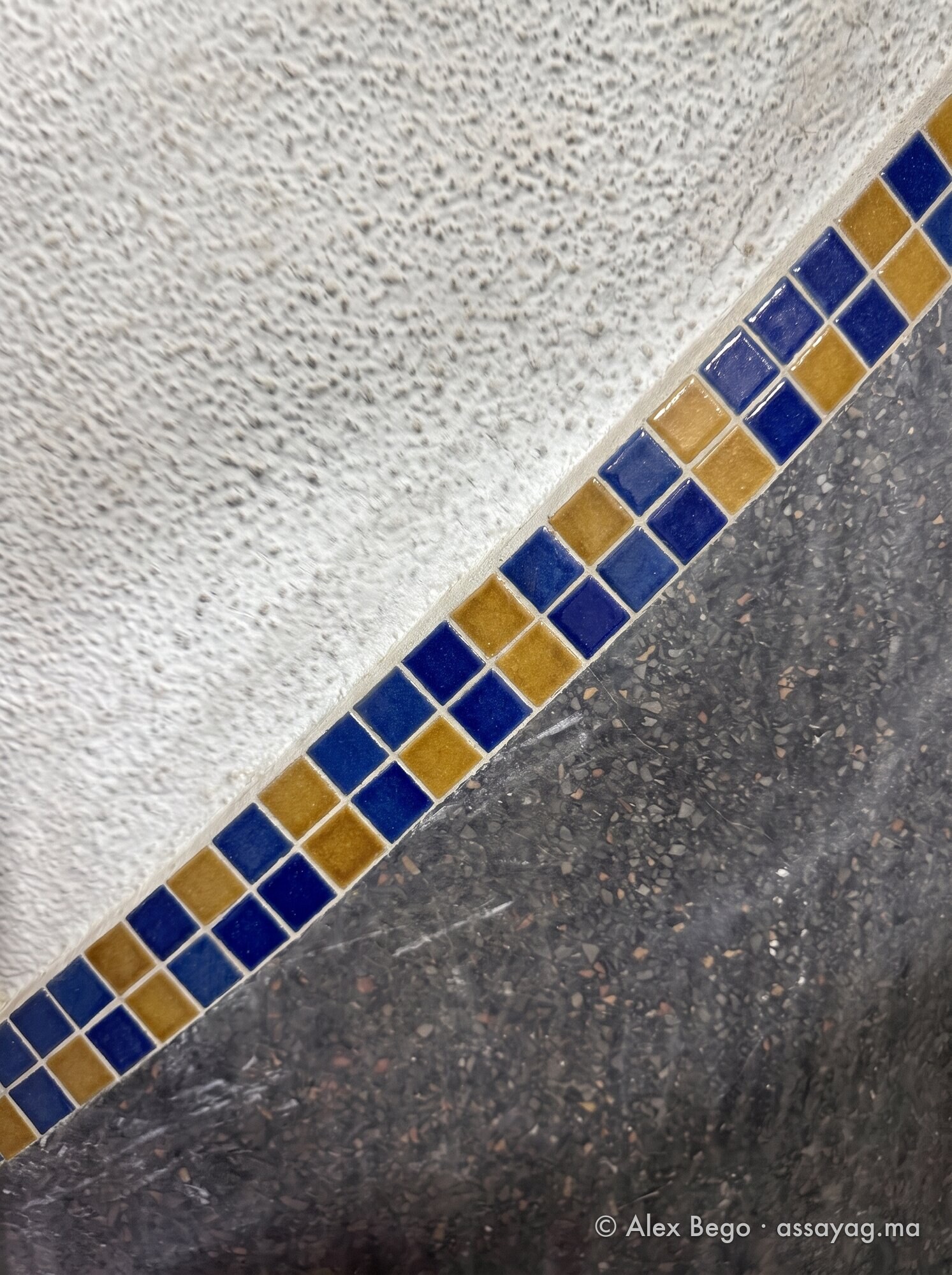
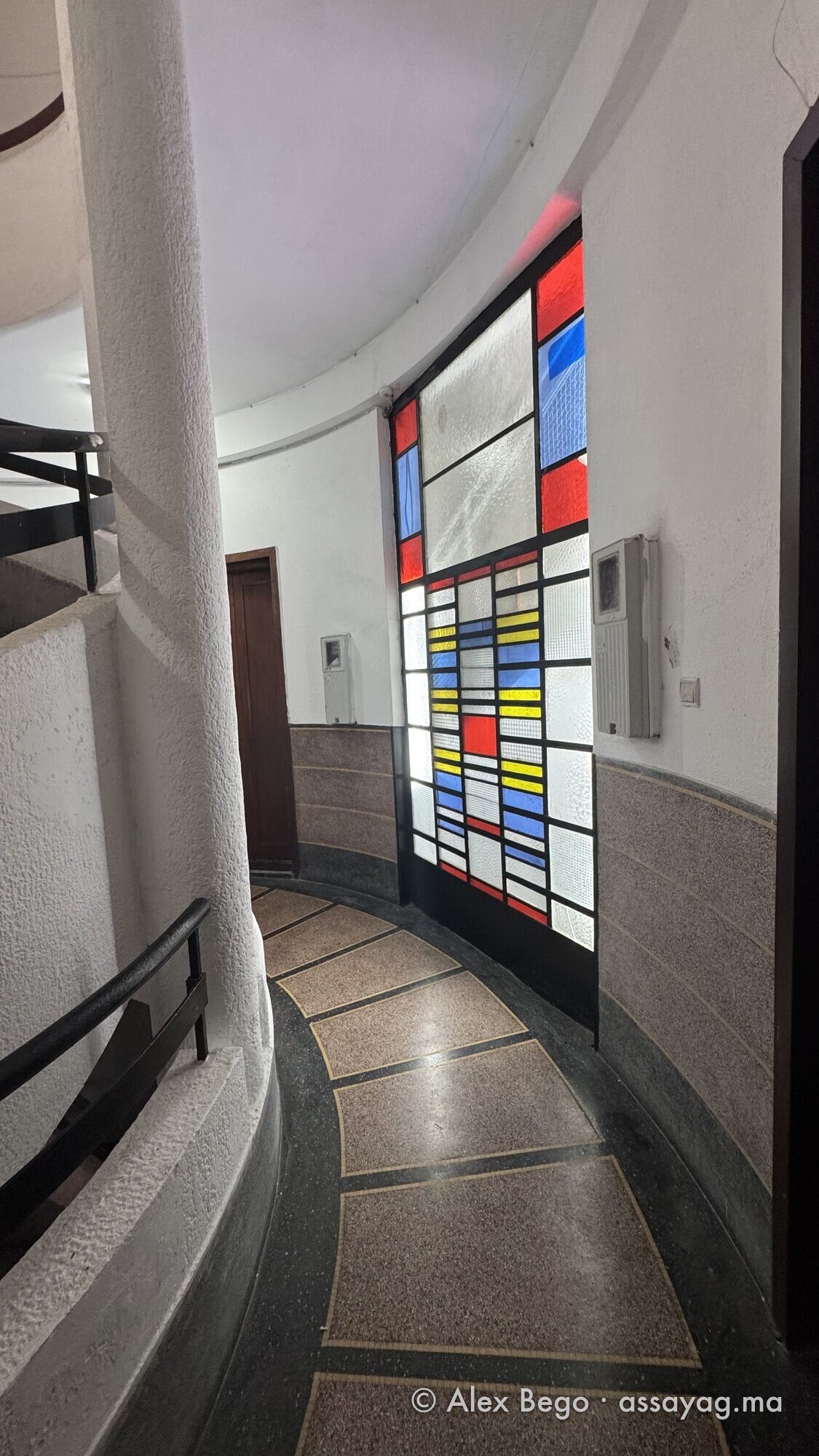
At the Assayag the same floor covers the landings of every storey and runs around the circular staircase, which has twenty-one marble steps to each storey, every one cut from a single block. It combines a few motifs: red-brown trapezoids on a black ground, edged with a line of yellow mosaic, their border following the curve of the wall; an ochre field with large chips beside a fine-grained red-brown field, separated by lines of blue, ochre and garnet tesserae; black bands cutting the red-brown in front of the stair's stained glass. The decoration does not stop at the floor: the foot of the wall is a coved skirting, hollowed into a curve, cast in the same black granito as the border, and a row of blue and ochre tesserae marks the line where the rough render begins.
The thin yellow line around the trapezoids, which we first described as a gilt metal joint, is also a row of tesserae; the close-up photographs show it. This is the original floor, cast in 1930 with the building: a granito is not replaced, it is repaired and reground, and nothing on these landings points to a later intervention.
This album is part of the inventory The Art Deco detail.