
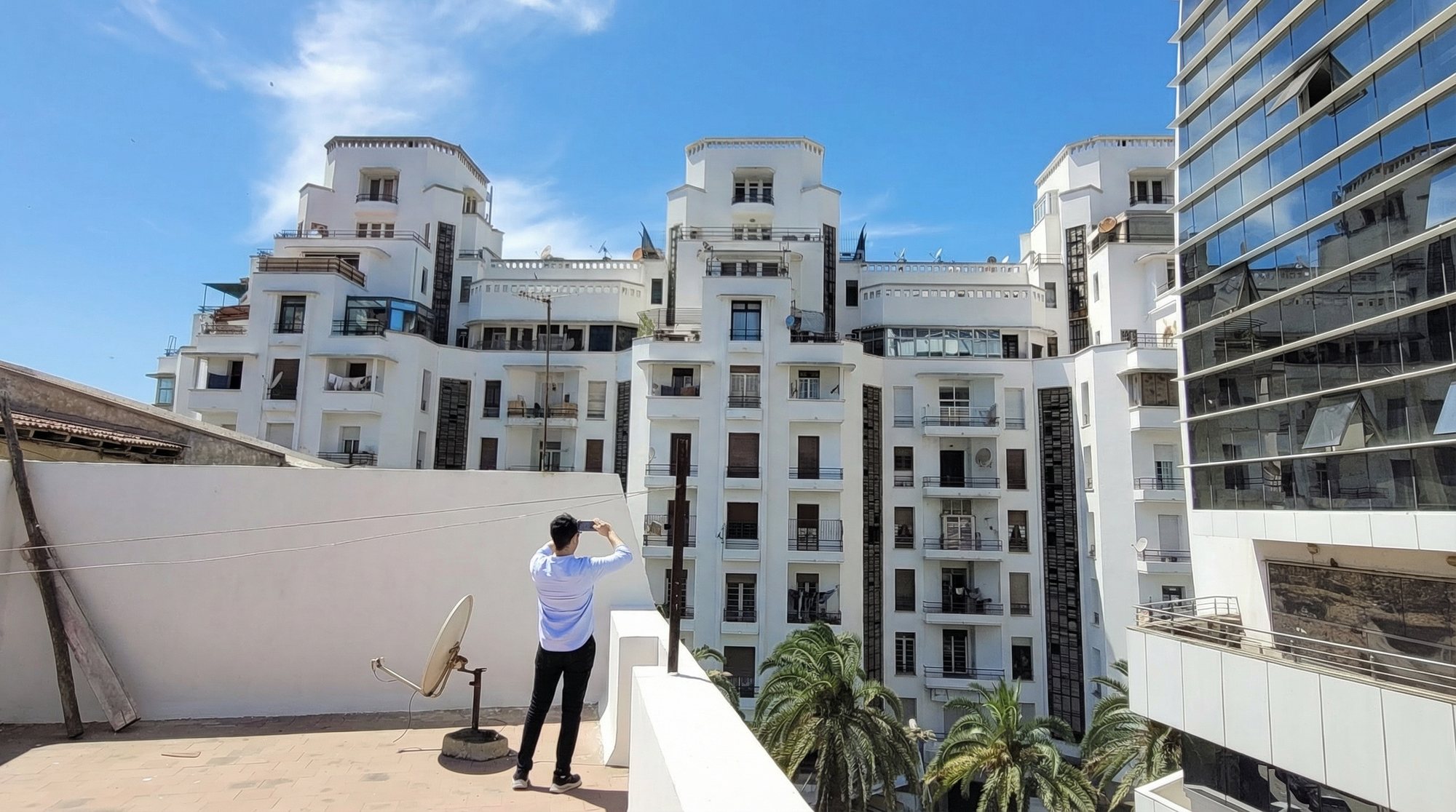
A block like the Assayag is not born in a quiet city. It is born in a city short of everything — and of space first of all.
The figures of an explosion
The demographic curve of Casablanca resembles no other in Morocco. Five hundred inhabitants around 1850; a thousand in 1857; nine thousand in 1885; thirteen thousand in 1892; twenty-one thousand in 1900; twenty-five thousand in 1907.
Then the pace changed in kind. In 1914, of the fifty thousand Europeans living in Morocco, thirty-one thousand were in Casablanca — half of them French. After the war the whole city took off: from sixty-three thousand inhabitants in 1916 it rose to a hundred and twenty thousand in 1927, to some hundred and sixty thousand at the 1931 census and to two hundred and sixty thousand in 1936 — a city on the scale of Bordeaux or Algiers. Observers of the day had only one comparison on their lips: the city was growing “like an American city”.
Who came, and why
The newcomers did not form a single bloc. First came the Moroccans of the Chaouïa tribes, notably the Mediouna, on whose lands the city had been built; then, in times of prosperity, migrants from more distant regions — the Draa, the Souss. Many lived by casual work: day labourers, boatmen, unskilled hands.
Then came the merchants of Fès, fewer in number but influential, who maintained ties with the foreign trading houses. And the Europeans: fifteen in 1856, sixty in 1868, more than two hundred in 1878, at that date mostly Spanish and English — the French then made up no more than 16% of the colony.
One and the same engine drew them all: a city where, within a few years, one could build a fortune or simply find work.
The port, a vital question
Everything depended on the port. In 1912, Resident-General Lyautey admitted that he had “not been convinced” of the case for a port at Casablanca — before bowing to the obvious: it was inevitable.
The storm of January 1913 settled the argument: seventeen lighters, a tug and three merchant ships were destroyed or driven ashore. The trade of a great city could no longer be passed through an open roadstead. On 15 July 1919 the first kilometre of the great jetty was laid; there Lyautey delivered a speech that has remained famous.
Cement, or the material condition
A city that builds upwards needs an industry that can keep up with it. From 1913, concrete blocks were being made at El Hank out of sand and cement, and the works of the Société des chaux et ciments du Maroc opened the same year in Casablanca.
This technical detail is decisive: without local cement production, no blocks of eight or ten storeys. The three towers of the Assayag, twenty years later, rest literally on that fledgling industry.
A city inventing itself in disorder
Growth did not come without friction. The Resident-General had only part of the military land at his disposal for the needs of administrative building, in a city developing in anarchic fashion; it would fall to the great public works both to bring order to this “urban flood” and to put the unemployed to work.
The architect Albert Laprade, returning to Casablanca after a long absence, was struck by it: a straight boulevard lined with young trees near the station, the avenue du général d’Amade, the Grande Poste, the place administrative, the parc Lyautey — none of it had existed in the city of waste ground and cart ruts that he had known.
What that produced
Set the elements side by side: a population multiplying tenfold, a port under construction, a cement industry starting up, land in the centre growing ever more expensive, and authorities encouraging building upwards in order to weld the port to the business district.
In that context, a ten-storey block was no longer an extravagance: it was an answer. It remained to find someone to finance it and an architect to give it form.
Frequently asked questions
How many inhabitants did Casablanca have before its growth?
About five hundred around 1850, twenty-one thousand in 1900 and twenty-five thousand in 1907.
When did the city grow fastest?
After the First World War: the city grew from sixty-three thousand inhabitants in 1916 to a hundred and twenty thousand in 1927, then to two hundred and sixty thousand in 1936.
Why was the port so important?
Because the whole economy depended on it. The storm of January 1913, which destroyed several ships, forced the decision; work on the great jetty began in July 1919.
What part did the cement industry play?
A decisive one: local production of concrete blocks and the opening of a cement works in 1913 made possible the tall blocks of the 1930s.
Source: Jean-Louis Cohen and Monique Eleb, “Casablanca. Mythes et figures d’une aventure urbaine”, Éditions Hazan.
💬 Comments
No comments yet. Be the first!